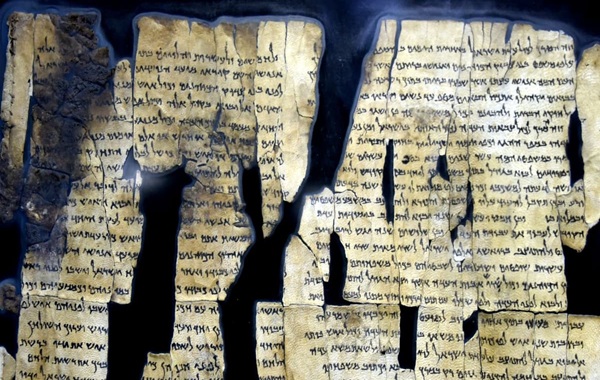
Biblical bombshell: Mysterious Dead Sea Scrolls decrypted with AI to reveal accurate date
In a recent development, AI has been deployed to date the Dead Sea Scrolls with astounding accuracy, radically challenging misconceptions regarding their age and the historical timelines they fall under.
The results show that several of the Scrolls might actually be much older than what is assumed, and in some cases, could be from the era of the biblical figures that supposedly wrote them.
Pioneered by the University of Groningen, this multidisciplinary work merges radiocarbon dating, ancient handwriting analysis, and machine learning.
The outcome is Enoch, the first AI system that can derive probabilistic dates from the script of Hebrew and Aramaic manuscripts, providing estimates based solely on the script’s stylistic elements.
“With the Enoch tool we have opened a new door into the ancient world, like a time machine, that allows us to study the hands that wrote the Bible, especially now that we have established, for the first time, that two biblical scroll fragments come from the time of their presumed authors,” say the authors.
The problem with traditional dating
The Dead Sea Scrolls are typically recognized as having been composed in the 3rd century BCE to the 2nd century CE. While these are the general estimates, dates for individual scrolls still seem to pose problems.
For this purpose, the researchers collected new radiocarbon dates from 24 scroll samples. This real data anchored the researchers’ machine learning model within concrete timelines, thus filling a significant void in the assumed chronological framework.
The goal was to train Enoch using the BiNet. BiNet is a neural network that not only analyzes scanned images of the scrolls, but extracts features such as the curvature of ink strokes and the shapes of letters.
The model’s predictions were validated against the radiocarbon data, showing an uncertainty margin of about ±30 years—narrower than that of radiocarbon dating alone for texts from 300–50 BCE.
Key revelations and broader impact
The team dated 135 scroll manuscripts using Enoch. In many instances, the AI model validated prior scholarly estimates. But in some cases, it contested them.
Most strikingly, Enoch dated two biblical scroll fragments to the periods traditionally associated with their authors, which is a first in Dead Sea Scroll research. It also found that Hasmonaean-type script appears earlier than the commonly accepted 150-50 BCE date range, and that Herodian script emerged earlier than previously believed, suggesting these styles coexisted from the late second century BCE.
These findings are critical to early Judaism and Christianity studies. Scholars can now better connect the scrolls with pivotal historical events, such as the emerging Hasmonaean dynasty and the development of new religious movements, due to refined timelines provided by the scrolls.
“It is very exciting to set a significant step into solving the dating problem of the Dead Sea Scrolls and also creating a new tool that could be used to study other partially dated manuscript collections from history. This would not have been possible without the collaboration between so many different scientific disciplines,” conclude the authors.
Source: Interesting Engineering
Traces of Mysterious Ancient Human Population Discovered in Colombia
Biblical bombshell: Mysterious Dead Sea Scrolls decrypted with AI to reveal accurate date