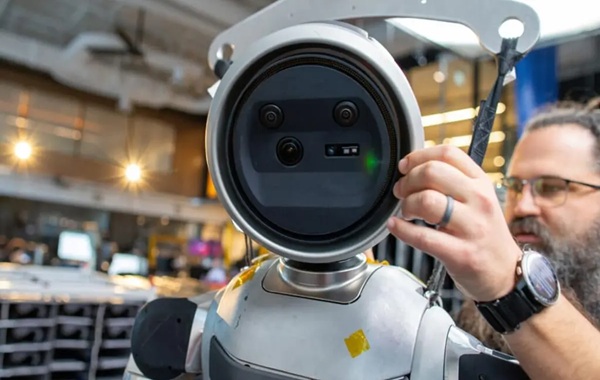
Atlas gets real-world upgrade with superhuman vision and near-perfect object tracking
Boston Dynamics has unveiled a major leap in robotics with a new perception system for Atlas, its humanoid robot.
The upgrade gives Atlas the ability to understand its environment with precision, enabling it to perform complex tasks in factory and industrial settings autonomously.
While the robot’s agility has long drawn attention, the company now emphasizes the critical role of perception in enabling real-world autonomy.
A robot like Atlas must interact with a world full of shiny, dark, or tightly packed objects.
That means simply picking up a part and placing it correctly demands advanced reasoning.
Boston Dynamics designed the robot’s vision system to handle these challenges through a combination of 2D and 3D awareness, object pose tracking, and tight calibration between what it sees and does.
2D detection lays the groundwork
Atlas starts by scanning its surroundings with a 2D object detection system. This system identifies relevant objects and hazards, assigning bounding boxes and keypoints to each item.
In factory environments, Atlas frequently interacts with storage fixtures of various shapes and sizes.
Fixtures are analyzed using outer and inner keypoints. The outer ones define the object’s general shape, while inner keypoints pinpoint internal slots.
These provide the ability to localize individual slots with precision. The perception models must work in real time, balancing performance with speed to keep up with Atlas’s movements.
3D localization tackles occlusion and clutter
To manipulate parts inside a fixture, Atlas estimates its position relative to the object. A dedicated localization module aligns observed keypoints with a stored model. It also integrates motion data to maintain accuracy over time.
This process addresses common issues like occluded keypoints or misleading angles. The combination of inner and outer keypoints produces a more reliable estimate of the pose of the fixture and all of its slots.
Even when the fixtures look identical, Atlas relies on spatial memory and context to distinguish between them.
Object tracking keeps Atlas on target
Once Atlas grabs a part, it must track it through space. The robot’s SuperTracker system fuses kinematic, visual, and force data. This allows Atlas to know if the object slips or moves out of view.
Pose estimation uses synthetic training data and matches real images with CAD renderings. The system filters pose predictions using self-consistency checks and kinematic constraints.
These filters enforce alignment between what Atlas sees and what its body feels, refining the part’s position with millimeter accuracy.
Calibrated coordination ties it all together
To execute fine movements, Atlas depends on extremely precise calibration. Its internal model of its limbs must align almost perfectly with its camera feed.
The alignment must be nearly perfect, with its arms, legs, and torso lining up exactly where the robot believes they are.
The camera and motion calibration compensate for wear, temperature changes, and manufacturing variance. These refinements ensure Atlas not only sees its surroundings clearly but can also act on them reliably.
Boston Dynamics says this is only the beginning.
The next step is to build a unified foundation model, where seeing and doing aren’t separate tasks but part of the same process.
Source: Interesting Engineering
Scientists develop flexible ultrasonic receiver that charges devices through water
Atlas gets real-world upgrade with superhuman vision and near-perfect object tracking/Atlas gets real-world upgrade with superhuman vision and near-perfect object tracking