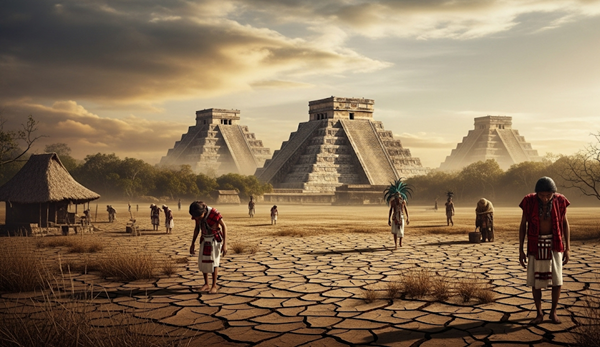
Are We Headed for the Same Fate as the Ancient Maya?
A new study using chemical fingerprints trapped in Mexican cave stalagmites has revealed the devastating extent of droughts that contributed to the collapse of the astonishing Classic Maya civilization over 1,000 years ago. Researchers from the University of Cambridge have uncovered evidence of a catastrophic 13-year drought and seven other prolonged dry periods lasting at least three years each, providing the first detailed, season-by-season account of climate conditions during the Terminal Classic period (871-1021 AD) when Maya society experienced massive upheaval.
The research, published in the journal Science Advances, represents a breakthrough in understanding one of archaeology’s mysteries: what caused the dramatic decline of Maya cities across the Yucatán Peninsula during the 9th and 10th centuries. By analyzing oxygen isotopes preserved in a stalagmite from Grutas Tzabnah cave in northwest Yucatán, the team achieved unprecedented precision in reconstructing ancient climate patterns, isolating rainfall data for individual wet and dry seasons across 150 years of Maya history.
Previous research has long suggested that drought played a role in Maya societal collapse, but this study provides the most detailed chronological framework yet for understanding exactly when and how severely these climate stresses affected the civilization. The findings align remarkably with archaeological evidence, including the cessation of monument construction at major sites like Chichén Itzá during periods of extreme drought.
Revolutionary Cave Analysis Reveals Seasonal Climate Patterns
The key to this breakthrough lies in the remarkable properties of stalagmites as natural climate archives. As water drips from cave ceilings over thousands of years, minerals precipitate and build up these formations layer by layer, trapping chemical signatures of the climate conditions when each layer formed. The Cambridge team, led by Dr. Daniel H. James, focused on a particularly well-preserved stalagmite with annual layers approximately one millimeter thick – thick enough to distinguish between wet and dry seasons.
“Being able to isolate the wet season allows us to accurately track the duration of wet season drought, which is what determines if crops succeed or fail,” explained James, who conducted the research while a PhD student at Cambridge’s Department of Earth Sciences and is now at University College London. This seasonal resolution represents a significant advance over previous climate studies using lake sediments, which can only provide annual averages and lack the detail needed to understand agricultural impacts.
The oxygen isotope analysis revealed eight distinct wet season droughts lasting at least three years between 871 and 1021 AD, with the longest drought persisting for an unprecedented 13 consecutive years. Even with the sophisticated water management systems that the Maya had developed, including reservoirs, canals, and underground storage facilities, such prolonged dry periods would have overwhelmed their capacity to maintain agricultural production and support dense urban populations.
Direct Correlation with Archaeological Evidence
What makes this climate data particularly compelling is how precisely it aligns with the archaeological record. The stalagmite’s drought chronology corresponds remarkably well with periods when Maya cities stopped erecting monuments with dated inscriptions – a practice that had been central to Maya political and religious life for centuries. During the most severe drought periods, major centers like Chichén Itzá ceased all monumental construction activity.
“This doesn’t necessarily mean that the Maya abandoned Chichén Itzá during these periods of severe drought, but it’s likely that they had more immediate things to worry about than constructing monuments, such as whether the crops they relied on would succeed or not,” noted James. The correlation suggests that even the most powerful Maya centers, with their extensive trade networks and accumulated wealth, could not escape the impacts of prolonged climate stress.
The research builds upon decades of work linking climate change to Maya societal transformation. Since the 1990s, scientists have increasingly recognized that environmental factors played a crucial role in the Terminal Classic collapse, but previous studies lacked the temporal resolution to understand exactly how climate and society interacted during this critical period.
Implications for Understanding Civilization and Climate
The findings have profound implications for understanding how complex societies respond to environmental stress. The Maya were among the most sophisticated civilizations of the ancient world, with advanced knowledge of astronomy, mathematics, writing, and agriculture. They had successfully adapted to the challenging environment of the tropical lowlands for over a millennium, developing innovative techniques for water management and intensive farming. Yet even this remarkable civilization could not withstand the compounding effects of repeated, prolonged droughts.
The study also highlights the value of high-resolution paleoclimate records for understanding past human-environment interactions. “This period in Maya history has been a cause of fascination for centuries,” James observed.
“There have been multiple theories as to what caused the collapse, such as changing trade routes, war or severe drought, based on the archaeological evidence the Maya left behind. But in the past few decades, we’ve started to learn quite a lot about what happened to the Maya and why, by combining the archaeological data with quantifiable climate evidence.”
Broader Context and Future Research
The Terminal Classic period represents one of the most dramatic societal transformations in human history. Within a few centuries, the great cities of the southern Maya lowlands were largely abandoned, political dynasties collapsed, and population centers shifted northward. While multiple factors contributed to these changes – including warfare, political instability, and economic disruption – the new stalagmite data demonstrates that climate stress was a persistent background condition that likely amplified other social tensions.
Looking forward, the researchers suggest that similar high-resolution climate records from other caves in the region could provide even more detailed insights into the Maya collapse. “In addition to what stalagmites can tell us about this period in Maya history, they might also be able to tell us about the frequency and severity of tropical storms, for instance,” James noted. Such records could illuminate not just drought patterns but also the full range of climate variability that ancient Maya societies had to navigate.
Source: Are We Headed for the Same Fate as the Ancient Maya?
Intense UV Rays from Strong Sunshine may have Killed the Neanderthals
Intense UV Rays from Strong Sunshine may have Killed the Neanderthals
Are We Headed for the Same Fate as the Ancient Maya?