Are Brown Dwarfs Really Failed Stars – Or the Missing Link Between Planets and Suns?
Rare Quadruple Star Systems Offer New Insights Into Brown Dwarfs
Brown Dwarfs: Failed Stars or Something More?
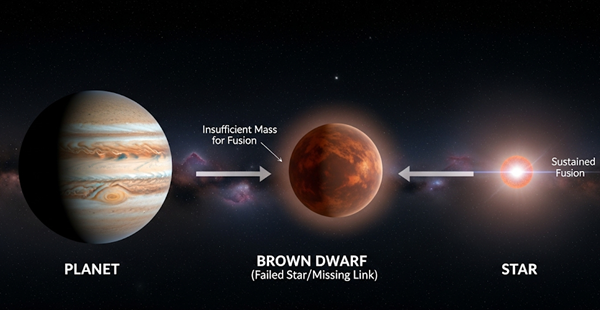
Astrophysicists know some things about brown dwarfs—and many things they don’t. These objects are too small to ignite hydrogen fusion like stars, yet too massive to be classified as gas giant planets. Instead, they fuse a little deuterium before cooling into obscurity. For this reason, they sit in a gray zone between stars and planets, often nicknamed “failed stars.”
But what if these elusive objects are not failures at all, but the key to bridging our understanding of stars and giant exoplanets?
The Mass Degeneracy Problem in Brown Dwarf Research
Brown dwarfs are notoriously difficult to study. Unlike main sequence stars, they cool over time, meaning their temperature, luminosity, and spectrum change. This complicates observations: is a faint brown dwarf old and massive, or young and lightweight?
This ambiguity is known as the mass degeneracy problem. Compounding the issue, brown dwarfs have almost the same radius regardless of mass, because they are supported by electron degeneracy pressure, not thermal pressure. How, then, can scientists accurately determine their true mass and age?
Why Rare Multiple Star Systems Are a Breakthrough
The answer lies in context. When brown dwarfs are found orbiting other stars—particularly in rare multi-star systems—they provide powerful benchmarks. That’s why the discovery of a quadruple star system containing both red dwarfs and brown dwarfs only 82 light-years away is such a game-changer.
Named UPM J1040–3551 AB, the system includes a binary pair of M dwarfs (red dwarfs) and a binary pair of T-type brown dwarfs. Together, they form a stable hierarchical structure: the two pairs orbit each other over 100,000 years.
Is this stability the cosmic laboratory astrophysicists have been waiting for?
Benchmark Brown Dwarfs: A New Tool for Astrophysics
In their research, Professor Zenghua Zhang of Nanjing University and colleagues describe why such systems are invaluable. Since all four objects formed from the same molecular cloud, they share the same age and metallicity. This eliminates guesswork and creates reliable benchmarks for brown dwarf science.
The red dwarf pair (designated Aab) each has about 17% of the Sun’s mass and surface temperatures near 2,900°C. The brown dwarf pair (Bab), by contrast, is much smaller—similar in radius to Jupiter—but far denser. With temperatures of just 550°C and 420°C, they are almost invisible in visible light, shining faintly only in the near-infrared.
By comparing these objects under the same environmental conditions, astrophysicists can refine evolutionary and atmospheric models that have long been plagued by uncertainty.
A Breakthrough in Age and Mass Calibration
Traditionally, scientists relied on luminosity to determine both mass and age of brown dwarfs—creating a circular dependency. But now, the presence of H-alpha emissions from the red dwarf pair provides an independent age estimate: between 300 million and 2 billion years old.
This solves one half of the mass degeneracy problem. The other half comes from the wide separation of the brown dwarfs. Because they orbit far from the red dwarfs—1,656 astronomical units away—there are no confusing factors like tidal heating, mass transfer, or orbital decay.
Could this system finally allow astrophysicists to measure brown dwarf masses with unprecedented accuracy?
The Role of Gaia and Infrared Observations
The discovery relied on data from the ESA’s Gaia mission and NASA’s Wide-field Infrared Explorer, followed by detailed spectroscopic observations at Chile’s SOAR Telescope. Gaia’s precision even detected the tiny wobble of the red dwarf pair, confirming its binary nature.
For the brown dwarf pair, unusual brightness suggested a binary, later confirmed through spectral analysis. Without such instruments, these faint cosmic objects would have remained hidden.
Why This Quadruple Star System Matters
“This is the first quadruple system ever discovered with a pair of T-type brown dwarfs orbiting two stars,” explains Dr. MariCruz Gálvez-Ortiz of the Center for Astrobiology in Spain. “The discovery provides a unique cosmic laboratory for studying these mysterious objects.”
Professor Adam Burgasser of UC San Diego adds: “It can serve as an age benchmark to calibrate low-temperature atmosphere models, and as a mass benchmark to test evolutionary models if we can resolve the brown dwarf binary and track its orbit.”
So, are these faint companions truly the missing link between stars and planets?
Looking Ahead: Bridging Stars, Brown Dwarfs, and Exoplanets
Brown dwarfs like those in L 122–88 AB and UPM J1040–3551 AB may finally help close the gap between giant exoplanets and the smallest stars. By providing benchmarks across temperature, mass, and metallicity, they unlock data scientists have sought for decades.
As the researchers conclude: “These systems may provide crucial insights into bridging the gap between brown dwarfs and giant exoplanets, contributing to a more comprehensive understanding of the stellar–substellar–planetary continuum.”
The universe, it seems, may have hidden its answers not in isolated stars, but in the delicate orbits of rare and dim cosmic families.
Source: Are Brown Dwarfs Really Failed Stars – Or the Missing Link Between Planets and Suns?
Could Callisto’s Gravity Unlock a New Era of Jovian Exploration?
Could Callisto’s Gravity Unlock a New Era of Jovian Exploration?
brown dwarfs, quadruple star system, failed stars, mass degeneracy problem, cosmic discoveries