Ancient Messages in Stone: Who Created These Enigmatic Spirals?
Ancient symbols carved into stone rarely speak plainly. Yet when beautiful petroglyphs discovered in Venezuela give hints of ancient culture, they force us to reconsider timelines, beliefs, and the symbolic sophistication of early societies in northern South America.
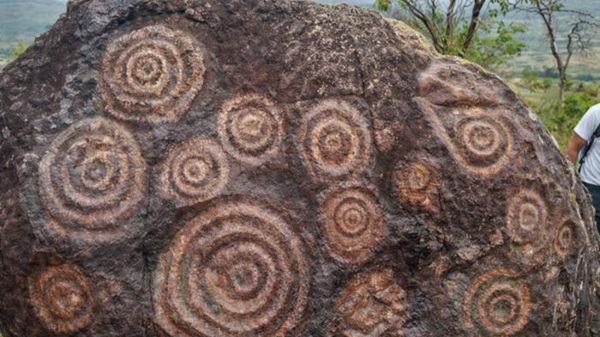
A newly recorded set of rock carvings in Venezuela’s Monagas state is now being described as potentially among the country’s oldest known examples of rock art. Researchers estimate an age ranging from four thousand to eight thousand years. If confirmed, this discovery could reshape prevailing interpretations of early symbolic traditions in eastern Venezuela. But how secure are these early estimates? And what do the spirals and anthropomorphic figures actually represent?
Ancient Rock Art Discovery in Venezuela: Petroglyphs in Cedeño’s Quebrada Seca Highlands
The petroglyph panel was located in a highland sector of the Quebrada Seca community in Cedeño Municipality, within Monagas state. The site lies approximately three and a half kilometers from the town of San Félix, at an elevation of roughly six hundred and fifty meters above sea level.
The discovery was publicly announced by Cedeño’s mayor, Daniel Monteverde, in collaboration with a commission connected to Venezuela’s National Land Institute. According to local reports, the site had been identified following systematic field surveys and location work carried out over a defined period.
The engravings appear on a naturally formed rock surface. Spirals, concentric circles, and human-like figures are carved with remarkable precision. The carving technique has been described as low-relief and linear, typically achieved through abrasion and pecking using stone tools. In some cases, sand and water may have served as abrasive agents.
Importantly, Cedeño is often described locally as the “petroglyph capital” of Monagas. Numerous indigenous vestiges have been documented in the broader region. Therefore, this find does not stand in isolation. Rather, it strengthens the argument that eastern Venezuela hosted a long-standing and symbolically rich cultural tradition.
However, what motivated ancient artists to carve such enduring marks into stone? Were these images ritual, territorial, astronomical—or something else entirely?
Dating the Petroglyphs: Can These Venezuelan Rock Carvings Really Be 8,000 Years Old?
The reported age range—between four thousand and eight thousand years—has attracted considerable attention. Yet caution must be exercised. Petroglyphs are notoriously difficult to date directly. Unlike organic remains, carved stone cannot easily be subjected to radiocarbon analysis.
Instead, researchers rely on indirect methods. These include contextual archaeological materials, stylistic comparisons, erosion and patina studies, and superimposition sequences. Consequently, the current age estimate appears to be based primarily on relative and stylistic assessment rather than laboratory confirmation.
This distinction is crucial. While the possibility of an eight-thousand-year antiquity is compelling, scientific validation will require further interdisciplinary study.
Nevertheless, comparisons with other Venezuelan sites provide context. In two thousand twenty-four, archaeologists working in Canaima National Park reported dozens of rock art sites featuring both pictograms and petroglyphs. These discoveries, widely discussed in outlets such as Live Science, suggest that complex symbolic landscapes once extended across vast portions of the country.
Thus, although the Monagas carvings belong to a different region, they fit into a broader pattern of under-documented prehistoric expression. If the higher age estimate is confirmed, could eastern Venezuela represent one of the earliest hubs of symbolic engraving in the Orinoco basin?
Symbolism in Venezuelan Petroglyphs: Cosmology, Water Cycles, and Solar Imagery
The geometric and anthropomorphic forms at Quebrada Seca are being tentatively interpreted through comparative frameworks. Across the Americas, spirals often appear in association with cosmological cycles, solar symbolism, or water-related rituals. Concentric circles may represent celestial bodies, while stylized human forms frequently allude to ancestors or spiritual intermediaries.
However, interpretation remains speculative. Without associated habitation layers or datable artifacts, symbolic meaning must be inferred cautiously.
In many indigenous traditions of the Orinoco basin, landscape and spirituality were deeply intertwined. Rock faces near water sources or elevated terrain often served as communicative canvases. Therefore, placement may have been as significant as imagery.
A major two thousand twenty-four study discussed by Smithsonian Magazine examined monumental engravings along the Orinoco River. Those carvings—featuring large snakes, animals, and human figures—were estimated to be around two thousand years old. The study argued that visibility from river routes amplified their communicative power.
Although the Orinoco engravings are younger, they demonstrate how rock art functioned as public messaging within riverine societies. Could the Monagas petroglyphs have served a similar purpose within upland networks? Or did they mark sacred territory known only to initiated members of a community?
Protection, Conservation, and Sustainable Tourism: The Future of Venezuela’s Petroglyph Heritage
Discovery brings opportunity. Yet it also brings risk.
Once a rock art site becomes publicly known, vulnerability increases. Weathering accelerates deterioration. Human interference, even when unintentional, can cause irreversible damage. Light touching, chalking to enhance visibility, and repeated foot traffic gradually erode carved surfaces.
Local authorities have emphasized immediate geolocation and safeguarding measures. Vandalism prevention has been explicitly cited as a priority. Moreover, plans have been discussed to develop an archaeological tourism route grounded in sustainable practices.
The challenge is delicate. Public access can foster appreciation and economic benefit. Conversely, insufficient regulation may lead to irreversible loss.
Mayor Monteverde has indicated intentions to coordinate with national cultural heritage institutions to formalize certification and protection. If legal safeguards are enacted promptly, long-term preservation may be achievable.
Yet broader questions remain. How can fragile heritage be integrated into tourism without commodifying or degrading it? Can community stewardship models offer a sustainable path forward?
The Broader Orinoco Basin Context: Rock Art Traditions Across Deep Time
The Orinoco basin remains one of South America’s most archaeologically rich yet underexplored regions. Monumental engravings, pictographic panels, and lesser-known petroglyph clusters collectively reveal long timelines of human presence.
Therefore, the Quebrada Seca discovery should be viewed not as an isolated curiosity, but as part of an evolving cartography of ancient symbolic expression. Each newly documented site adds depth to the regional narrative.
Moreover, discoveries in Monagas complement findings elsewhere in the country. Together, they challenge simplified assumptions about the development of symbolic culture in northern South America.
If early dates are confirmed, the petroglyphs may push back the timeline of organized symbolic systems in eastern Venezuela by several millennia. That possibility alone demands rigorous study.
Why This Discovery Matters: Rethinking Ancient Culture in Eastern Venezuela
At first glance, the carvings are silent. Yet silence can be profound. Spirals, circles, and human forms etched thousands of years ago remain visible today. Their creators have vanished, but their symbolic vocabulary endures.
Scientific validation will determine whether these petroglyphs truly rank among Venezuela’s oldest. Even so, their existence underscores the sophistication of early inhabitants in Monagas state.
Consequently, the discovery raises enduring questions. Who carved these figures, and under what social conditions? What cosmology shaped their worldview? And how many similar sites remain undiscovered beneath vegetation and time?
In the end, the beautiful petroglyphs discovered in Venezuela do more than decorate stone. They challenge us to reconsider the depth of ancient culture in the region—and to ask whether we are only beginning to understand the symbolic landscapes of the past.
Source: Ancient Messages in Stone: Who Created These Enigmatic Spirals?
Ancient DNA suggests hunter-gatherers in Europe’s lowlands endured until 2500 BCE
Ancient DNA suggests hunter-gatherers in Europe’s lowlands endured until 2500 BCE
Ancient Messages in Stone: Who Created These Enigmatic Spirals?
Sources
Heritage Daily
Últimas Noticias
Live Science
Smithsonian Magazine
Ancient Messages in Stone: Who Created These Enigmatic Spirals?