Aboriginal artists painted giant ancestral beings as colonization arrived, study finds
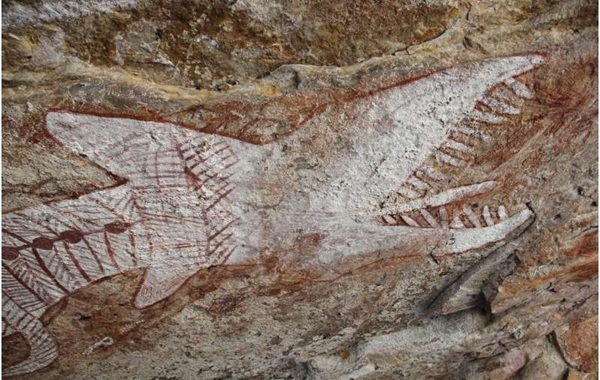
Slithering across the ceiling of an Australian rock shelter is a giant snake with a crocodile-like head, razor-sharp teeth and a long tongue. It’s more than 6 meters (20 feet) long, making it one of the largest Rainbow Serpent paintings ever recorded in Arnhem Land and adding to the curious repertoire of similarly giant paintings across the region.
According to a study published in Australian Archaeology, Aboriginal artists across the region began painting massive images of powerful ancestral beings during the 19th and 20th centuries. The goal was to exert control over their land, traditions and community in the face of rapid change as early European colonization upended the world they knew. The giant Rainbow Serpent was one of the images painted with this purpose.
“When I first saw the 6-meter (20-foot) Awunbarna Rainbow Serpent at site AW5, I thought to myself, “Wow! This is one of the largest Rainbow Serpent paintings I have seen in 40 years of Arnhem Land rock art fieldwork, and look at those teeth and tongue!'” said Paul Taçon, an archaeologist at Griffith University and lead author of the study.

Recording giants
Since 2018, Taçon and his colleagues have been working with senior Amurdak Traditional Owner Charlie Mungulda to record 165 rock art sites across the Awunbarna region, also known as Mount Borradaile. Their search has specifically focused on rock art made after European arrival.
What piqued their interest was the puzzling trend of post-contact art being depicted at a massive scale, from 2-meter-long (7-foot-long) pythons to life-sized crocodiles and kangaroos. Among the giants were the most powerful creatures of all: Rainbow Serpents.
Rainbow Serpents are ancestral beings with the power to fold time itself so that the Dreamtime is not just in the past but also continues into the present. They are tied to the idea of change and learning how to cope with, accept and perhaps even control it.
The team recorded 29 images of Rainbow Serpents across 21 sites, the largest concentration of these powerful beings anywhere. On top of that, the team also found a depiction of a giant man more than 2 meters (7 feet) long and the only known depiction of a baleen whale in all of Australia.
Giant depictions weren’t limited to paint, either; a 124-meter-long (407-foot-long) stone arrangement also caught their eye. “We could see from the shape of the stone arrangement, with a large head-like stone at the end of a winding neck attached to a large body outlined with stones, that it resembled some paintings of Rainbow Serpents,” Taçon said.
Exactly when these paintings were made is difficult to say. Many images cannot be radiocarbon-dated, Taçon said, but serpents are often layered over older art and are painted in mostly white pipe clay, a pigment that tends to fade in just a few centuries. According to the study, taken together, the evidence points to a post-contact date.
In the face of change
But why depict these giant creatures and beings in such large numbers? The study suggests that artists began painting giant, powerful creatures in an effort to reassert control amid rapid cultural upheaval. The giant paintings linked to ceremonies, myths, beliefs and traditions helped reinforce their connection to the land and its people.
Taçon says that Awunbarna’s location was particularly well suited to the depiction of these giants. “Awunbarna was a focal point between various Aboriginal language groups for trade, ceremonies and other social gatherings,” he said. People moving between neighboring lands had to pass through Amurdak Country, making it the perfect place to depict these paintings and get their message across. On top of that, it was one of the first places targeted by the colonial buffalo-shooting industry in the late 1800s, and thus the first hit by massive change.
Confronted with such massive upheaval, an equally powerful response was needed. “As the most powerful of all Ancestral Beings, the Rainbow Serpent was a potent force that could be used, through depictions, stories and ceremonies, to help give Aboriginal people some stability and control over their destiny in rapidly changing times by reinforcing traditions,” Taçon said.
Besides the rainbow serpents, other powerful creatures, including crocodiles, fish and other animals, were often painted over and next to European ships and firearms, a visual statement that the study says was made by ceremonial leaders to emphasize that Aboriginal tradition was still important.
For Taçon, the significance goes well beyond archaeology. “These paintings, a testament to Aboriginal creativity, tradition and worldview, were used to pass on important knowledge between generations and are part of an irreplaceable global visual heritage that has worldwide significance, contemporary relevance and is part of Aboriginal living culture,” he said.
Source: phys.org
1.4-million-year-old footprints reveal a surprisingly large human relative
Aboriginal artists painted giant ancestral beings as colonization arrived, study finds/Aboriginal artists painted giant ancestral beings as colonization arrived, study finds