A Secret Link Between Earth’s Core and Oxygen?
Could a Shifting Magnetic Field Rewrite the Story of Evolution?
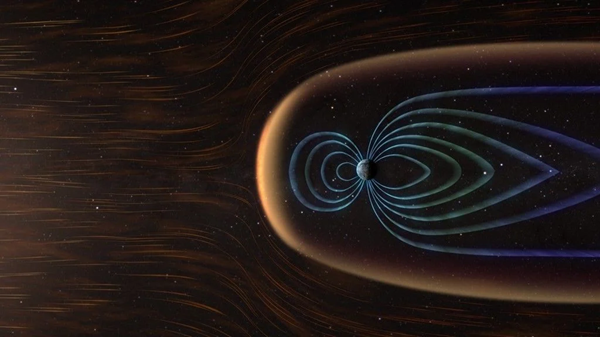
Deep within our planet, molten iron and nickel churn around the solid inner core in a counter-flowing motion relative to Earth’s rotation. This dynamic engine—known as the geodynamo—generates Earth’s magnetic field, the magnetosphere, which plays a critical role in shielding life from harmful cosmic and solar radiation.
However, this magnetosphere isn’t static. Variations in the flow of the molten outer core mean the strength of Earth’s magnetic field changes over time. Scientists have long believed that this field also plays a critical role in protecting our atmosphere from being stripped away by solar wind—a fate that likely befell Mars.
But is the magnetosphere doing more than just shielding the surface? Could it be intimately connected to how Earth retains its breathable air?
Magnetic Field and Atmospheric Oxygen: Surprising Parallels Across 540 Million Years
New research by NASA scientists suggests a remarkable correlation between shifts in Earth’s magnetic field and fluctuations in atmospheric oxygen levels over the past 540 million years. This groundbreaking study proposes that the deep interior of our planet may have a direct influence on atmospheric chemistry—a connection that could change how we understand planetary habitability.
The research was led by Weijia Kuang, a geophysicist at NASA’s Goddard Space Flight Center, in collaboration with scientists from the University of Washington and the University of Leeds. Their findings, published in Science Advances on June 13, 2024, open new doors in the fields of geophysics, geochemistry, and astrobiology.
How Rocks Became Time Capsules of Earth’s Magnetic and Oxygen History
Earth’s geological record preserves clues to these long-term changes. When magma reaches the surface and cools into solid rock, magnetic minerals within it align with the Earth’s magnetic field. These “fossil magnets” retain a snapshot of the magnetic field’s direction and strength at the time of formation.
Simultaneously, the chemical makeup of these rocks reflects the oxygen content of the atmosphere in which they formed. This dual archival function allows scientists to reconstruct a timeline of both magnetic and atmospheric evolution.
As Kuang explains:
“These two datasets are very similar. Earth is the only known planet that supports complex life. The correlations we’ve found could help us to understand how life evolves and how it’s connected to the interior processes of the planet.”
A Link Between Earth’s Core, Its Crust, and the Conditions for Life?
In analyzing datasets of magnetic field intensity and oxygen fluctuations, the research team found that major shifts in magnetic strength aligned with significant rises and falls in atmospheric oxygen. These changes date back to the Cambrian Explosion—the pivotal period 540 million years ago when complex life rapidly diversified.
This suggests a potential shared cause, such as tectonic activity or continental drift, which affects both the flow of molten material in the core and geological processes that regulate atmospheric gases.
Biogeochemist Benjamin Mills of the University of Leeds notes:
“This correlation raises the possibility that both the magnetic field strength and the atmospheric oxygen level are responding to a single underlying process, such as the movement of Earth’s continents.”
What Does This Mean for the Search for Life on Other Worlds?
This research doesn’t just reshape our understanding of Earth—it may influence how we search for habitable planets elsewhere. If a planet’s internal structure plays a role in maintaining a stable atmosphere, then life-supporting conditions may require more than just the right distance from a star.
Future studies will expand the scope to include earlier geological periods and explore the behavior of other critical atmospheric elements like nitrogen, potentially revealing a broader blueprint for habitability.
So we must ask:
Is the secret to life not just in the sky, but in the planet’s heart?The research team hopes to examine more datasets to test this correlation. This will include datasets that look back farther than the Cambrian Era, as well as those that catalog changes in other atmospheric components (like nitrogen) that are essential to life. These studies could reveal a vital connection between the interior dynamics of planets and habitability, which could also have implications for the search for life beyond Earth (astrobiology).
Source: A Secret Link Between Earth’s Core and Oxygen?