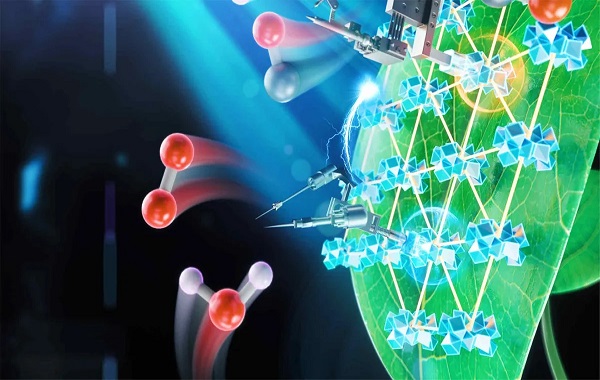
A newly created artificial photosynthesis system is 10 times more effective than existing systems
Chemists at the University of Chicago have devised a new system for artificial photosynthesis that fares better than previous artificial systems.
Published in Nature Catalysis, the six chemists discovered a method that could be used to produce other chemicals.
“Without natural photosynthesis, we would not be here. It made the oxygen we breathe on Earth, and it makes the food we eat,” University of Chicago chemist Wenbin Lin said in a statement. “But it will never be efficient enough to supply fuel for us to drive cars, so we will need something else.”
Lin added that even nature has no solution for the amount of energy we use. “We will have to do better than nature, and that’s scary,” said Lin.
Scientists are now hacking a plant’s systems to create our kind of fuel.
“This is a huge improvement on existing systems, but just as importantly, we were able to lay out a very clear understanding of how this artificial system works at the molecular level, which has not been accomplished before,” said Lin, who is the senior author of the study.
Scientists had to tinker with nature and re-engineer photosynthesis
Regular photosynthesis produces carbohydrates from carbon dioxide and water, but artificial photosynthesis could produce ethanol, methane, or other fuels.
Photosynthesis creates carbohydrates that could fuel us, but not our cars. So, the researchers who delved deep to create alternates to fossil fuels had to “re-engineer the process to create more energy-dense fuels, such as ethanol or methane,” as per the release.
Proteins and pigments in a leaf take in water and carbon dioxide, break the molecules apart, and rearrange the atoms to make carbohydrates. Scientists had to produce a different arrangement – just hydrogen surrounding Ch4, methane.
Amino acids to the rescue
Tinkering with it, however, wasn’t easy; people have been trying for decades. But Lin and team added an element that artificial photosynthesis systems haven’t included: amino acids.
They noticed that amino acids helped the reaction be more efficient. However, artificial photosynthesis is still a long way from producing enough fuel for widespread use. “Where we are now, it would need to scale up by many orders of magnitude to make a sufficient amount of methane for our consumption,” Lin said.
The method can also be applied to other chemical reactions. “So many of these fundamental processes are the same,” said Lin. “If you develop good chemistries, they can be plugged into many systems.” However, one needs to make a lot of fuel for it to have a significant impact.
Source: Interesting Engineering
Engineers developed a breakthrough method to generate hydrogen gas in one-step process
Engineers developed a breakthrough method to generate hydrogen gas in one-step process
A newly created artificial photosynthesis system is 10 times more effective than existing systems