Why Don’t the 7,000-Year-Old Ancient Mummies Found in the Sahara Desert Match Modern Human DNA?
When we hear Sahara, we picture endless sand and blistering heat. Yet, roughly seven thousand years ago, this now inhospitable region was a flourishing landscape of lakes, grasslands, and wildlife — known to scientists as the Green Sahara or African Humid Period. Recently, researchers made a discovery that challenges long-held assumptions about early human populations in this area: ancient remains whose DNA does not align with modern humans or expected African genetic patterns.
Green Sahara Pastoralists: Unexpected Genetic Clues
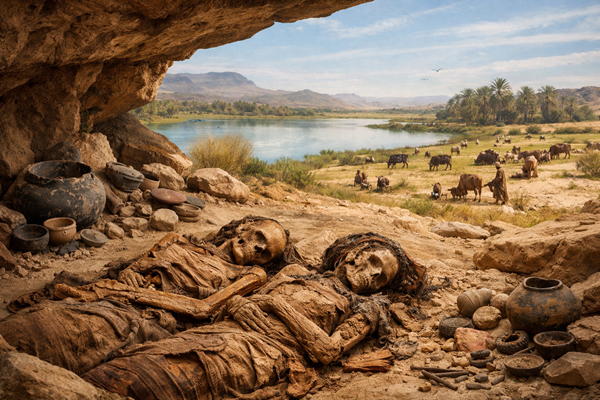
Two naturally preserved mummified women, discovered in the Takarkori rock shelter in southwestern Libya, have been the focus of a groundbreaking genetic study. These individuals lived during the Neolithic, a period when herding and early forms of farming were emerging in North Africa. Despite excellent archaeological preservation, scientists were amazed by what their genomes — extracted from bones and teeth — revealed.
Rather than showing clear links to modern Sub-Saharan populations, as many researchers expected, these women carried DNA largely derived from a previously unknown and deeply divergent North African lineage. Genetic analysis indicates this lineage split from other African groups roughly when early humans were migrating out of Africa, about fifty thousand years ago.
This discovery redefines our view of prehistoric human diversity on the continent.
Isolation in the Middle Sahara: What the DNA Shows
Contrary to traditional models of prehistoric human movement, the Takarkori genomes show that:
These individuals share closest genetic affinity with ancient foragers from Taforalt Cave in present-day Morocco, who lived around fifteen thousand years ago.
Their DNA does not show significant ancestry from Sub-Saharan African populations, despite the Sahara being greener and more habitable at the time.
Gene flow between northern and Sub-Saharan Africa during the African Humid Period may have been much more limited than previously thought.
These findings suggest that even during times of favorable climate, geographic and cultural barriers may have restricted genetic interchange across the vast Green Sahara.
Beyond Humans: Neanderthal Ancestry and Interactions
The Takarkori genomes also contain traces of Neanderthal ancestry — but at very low levels. Compared to most non-African populations alive today, these ancient individuals have around ten-fold less Neanderthal DNA, though still more than many ancient and modern Sub-Saharan Africans.
This mix implies some contact or shared ancestry with groups who had interbred with Neanderthals, but not enough to suggest major migrations or population replacements.
Pastoralism in the Sahara: Culture Over Migration
One of the biggest surprises from this research relates to the spread of animal herding and pastoral practices. Previously, many scientists assumed that pastoralism spread into North Africa through migrating farmers. However, the genetic evidence paints a different picture:
Cultural diffusion, rather than mass migration, likely introduced herding into the Green Sahara.
In other words, existing local populations adopted pastoral technologies from neighbors, without extensive gene flow.
This insight changes our understanding of how technology and lifestyle practices spread across prehistoric Africa.
How Did These People Live and Die? A Glimpse of Green Sahara Society
Archaeological evidence from Takarkori — including pottery, wooden tools, and plant remains — shows that these people lived in organized communities that managed livestock and created durable tools. Their environment resembled modern savannas, supporting animals like gazelles and hippos — very different from today’s barren sands.
Yet, as the African Humid Period ended and the Sahara dried, populations like the Takarkori herders seem to have vanished or integrated into other groups, leaving no direct genetic descendants in unadmixed form among humans today.
What Does This Mean for Human History?
These findings raise fascinating questions:
How many other ancient human lineages once existed but are now lost?
What role did climate shifts play in shaping human genetic diversity?
How did culture and technology spread across vast landscapes without major population movements?
By combining archaeology and genomics, scientists are beginning to answer these questions — and rewriting the story of humanity one ancient genome at a time.
Sources and Further Reading
Scientific Publications & Research Reports
First ancient genomes from the Green Sahara deciphered (ScienceDaily summary) — discusses the study findings, ancient genomes, and implications for North African lineages.
Detailed Nature journal research summary — highlights genetic divergence and archaeological interpretations.
Max Planck Institute press release — outlines team leaders, study context, and cultural diffusion of pastoralism.
Euronews overview — accessible explanation of genetic distances, Neanderthal ancestry, and regional implications (in Spanish)
Source: Seven-Thousand-Year-Old Ancient Mummies Found in the Sahara Do Not Match Modern Human DNA: So Who Were These Mummies?
Scientists Found an Ancient Human Relative Where None Was Expected
Scientists Found an Ancient Human Relative Where None Was Expected
Why Don’t the 7,000-Year-Old Ancient Mummies Found in the Sahara Desert Match Modern Human DNA?