Webb Just Saw the Universe’s First Light — But Why Does It Break Everything We Thought We Knew?
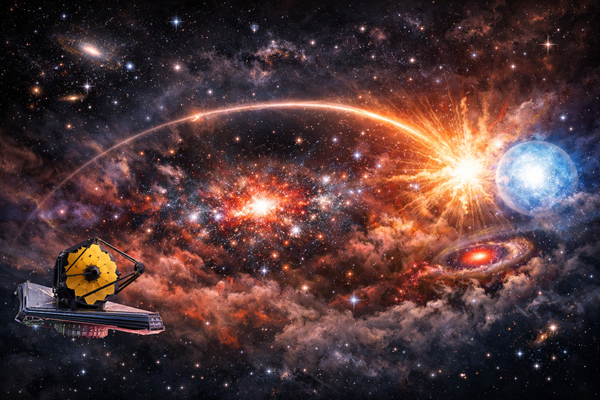
The NASA/ESA/CSA James Webb Space Telescope continues to redefine cosmic exploration. Once again, Webb pushes boundaries of the observable universe closer to the Big Bang with the confirmation of an extraordinarily bright galaxy that existed only two hundred eighty million years after the universe began.
This newly verified galaxy, named MoM-z14, is not just distant — it is a time capsule from the era astronomers call cosmic dawn. And what Webb is seeing there is nothing like what theory once predicted.
As Webb pushes boundaries of the observable universe closer to the Big Bang, scientists are being forced to rethink how fast galaxies formed, how stars evolved, and how light first escaped the darkness of the early cosmos.
But how did such a massive, luminous galaxy appear so quickly after creation itself?
How Webb Pushes Boundaries of the Observable Universe Toward Cosmic Dawn
Using its powerful NIRSpec (Near-Infrared Spectrograph) instrument, Webb measured MoM-z14’s redshift at fourteen point four four. That means the galaxy’s light has been stretched by cosmic expansion for about thirteen and a half billion years on its journey to us.
Because the universe is constantly expanding, distance is not simple to calculate. Instead of thinking in kilometers, astronomers look back in time. And Webb now lets humanity look closer to the Big Bang than ever before.
Rohan Naidu of MIT explains it clearly:
“With Webb, we are able to see farther than humans ever have before, and it looks nothing like what we predicted, which is both challenging and exciting.”
Images alone provide estimates, but spectroscopy confirms reality. That is why follow-up measurements are essential. Only then can astronomers know what they are truly seeing — and when.
So when Webb pushes boundaries of the observable universe closer to the Big Bang, it is not guesswork. It is precision science reshaping cosmic history.
Webb Pushes Boundaries of the Observable Universe by Revealing Surprisingly Bright Early Galaxies
Before Webb launched, models suggested that early galaxies would be faint, small, and rare. Instead, Webb is finding the opposite.
MoM-z14 belongs to a growing group of unexpectedly bright galaxies from the universe’s first few hundred million years. According to researchers, Webb is detecting nearly one hundred times more luminous galaxies than theory predicted.
That gap between expectation and observation is widening fast.
Jacob Shen from MIT describes the situation:
“There is a growing chasm between theory and observation related to the early universe.”
In other words, as Webb pushes boundaries of the observable universe closer to the Big Bang, the universe itself is refusing to follow our old rules.
Were stars forming faster?
Were galaxies assembling earlier?
Or is something fundamental missing from current models?
Each discovery deepens the mystery instead of closing it.
Webb Pushes Boundaries of the Observable Universe With Strange Nitrogen Signatures
One of MoM-z14’s most intriguing features is its chemical fingerprint.
Webb detected unusually high levels of nitrogen, something that normally requires several generations of stars to produce. Yet MoM-z14 existed when the universe was still extremely young.
So how could so much nitrogen appear so fast?
Naidu offers a fascinating comparison:
“We can look at ancient stars in our own galaxy like fossils from the early universe.”
Some of the Milky Way’s oldest stars show similar nitrogen enrichment. Webb is now seeing the same pattern directly in primordial galaxies.
The implication is powerful. The early universe may have produced supermassive stars, far larger than anything forming today. These giants could manufacture nitrogen rapidly and reshape young galaxies in ways astronomers never expected.
Once again, Webb pushes boundaries of the observable universe closer to the Big Bang — and reveals chemistry that challenges stellar evolution itself.
Webb Pushes Boundaries of the Observable Universe in Mapping Cosmic Reionization
Another major clue comes from how MoM-z14 interacts with its surroundings.
Early space was filled with thick neutral hydrogen fog that trapped light. Only after the first stars ignited did radiation begin clearing that mist in a process called reionization.
Webb was built partly to map this very era.
MoM-z14 already shows signs of punching holes through that primordial hydrogen, allowing light to travel freely across space for the first time.
By observing galaxies like this, Webb pushes boundaries of the observable universe closer to the Big Bang while also defining when the universe truly became transparent.
Without Webb, this phase of cosmic history would remain hidden forever.
How Webb Pushes Boundaries of the Observable Universe Beyond Hubble’s Legacy
Even before Webb, Hubble hinted that something strange was happening early on. Hubble discovered GN-z11, a bright galaxy existing about four hundred million years after the Big Bang.
Webb confirmed its distance — and then went much farther.
Each new observation stretches cosmic limits again. MoM-z14 now pushes humanity closer to the moment creation itself unfolded.
Yijia Li from Penn State sums it up:
“It’s an incredibly exciting time, with Webb revealing the early universe like never before.”
As Webb pushes boundaries of the observable universe closer to the Big Bang, it is no longer just observing space — it is rewriting the origin story of galaxies, stars, and light itself.
Final Thought: What Else Will Webb Reveal Near the Big Bang?
If galaxies like MoM-z14 already exist so early, what else is hiding beyond our models?
Did the first stars grow larger than physics allows today?
Did galaxies assemble in record time?
Could the early universe operate under rules we have not yet discovered?
One thing is certain:
Every time Webb pushes boundaries of the observable universe closer to the Big Bang, the cosmos answers with more questions than conclusions.
And perhaps that is the greatest discovery of all — not just how far we can see, but how much remains unknown.
Source: Webb Just Saw the Universe’s First Light — But Why Does It Break Everything We Thought We Knew?
The Planet Everyone Ignored: What Are These Lines Suddenly Revealing on Mercury?
The Planet Everyone Ignored: What Are These Lines Suddenly Revealing on Mercury?
Webb Just Saw the Universe’s First Light — But Why Does It Break Everything We Thought We Knew?