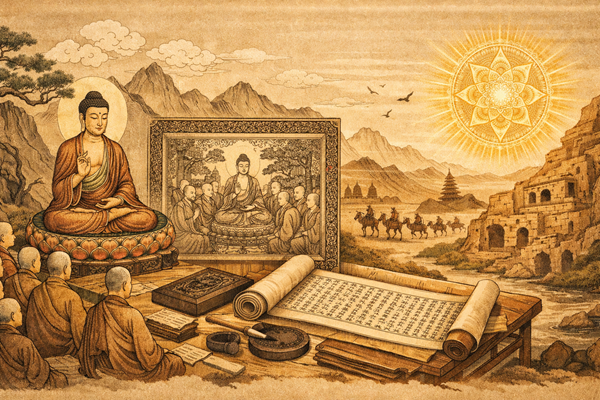
Was the Diamond Sutra, the world’s first printed book, written to awaken humanity?
What is the oldest printed book in the world? And how did a fragile Buddhist text survive more than a thousand years to reach us today? The answer leads directly to one extraordinary work: the Diamond Sutra, also known as the Vajracchedika Prajnaparamita Sutra.
Translated from Sanskrit, its name means “The Perfection of Wisdom that Cuts Like a Diamond.” Today, it stands not only as a spiritual masterpiece of Mahayana Buddhism, but also as the earliest complete surviving dated printed book in human history.
Let’s explore its philosophy, history, discovery, and global importance.
The Diamond Sutra in Mahayana Buddhism and Sacred Texts
The word sutra refers to a teaching or sermon traditionally attributed to the Buddha. In Mahayana Buddhism, the Diamond Sutra is among the most revered scriptures.
It belongs to the Prajnaparamita Sutras, meaning “Perfection of Wisdom.” Another famous text in this collection is the Heart Sutra. According to Buddhist tradition, Gautama Buddha dictated these teachings to his disciples. For centuries, they were believed to be hidden until humanity was ready to understand them.
However, modern scholars offer a different view. Instead of being composed all at once, the Prajnaparamita canon developed gradually over many generations. Although some of the sutras began to appear around the first century before Christ, the collection was completed only centuries later.
So, was the Diamond Sutra preserved by destiny, or by careful human transmission?
Meaning and Philosophy of the Diamond Sutra Text
Although short by religious standards, the Diamond Sutra carries remarkable depth. A typical English translation contains roughly six thousand words.
Its core message encourages readers to cut through illusion. The Buddha teaches that attachment to appearances, identity, and fixed ideas prevents true understanding. Therefore, wisdom arises when people release false perceptions and recognize the nature of reality itself.
In other words, the Diamond Sutra is not just read — it is experienced.
But how did this philosophical work become a historical artifact?
Chinese Translation and the Spread of the Diamond Sutra
The Diamond Sutra entered China through translation. In the early fifth century, the monk Kumarajiva translated the Sanskrit version into Chinese, making the text accessible across East Asia.
Later, Prince Zhao Ming, son of Emperor Wu of Liang, divided the sutra into thirty-two chapters, each with a title. These divisions are still widely used today.
Moreover, the text played a key role in Chan (Zen) Buddhism. According to tradition, Huineng, the sixth and last patriarch of Chan, attained enlightenment after hearing the Diamond Sutra recited while selling firewood in a market.
Can a single passage truly awaken a mind? Huineng’s story suggests that it can.
Mogao Caves Discovery and Dunhuang Manuscripts
At the start of the twentieth century, a Taoist monk named Wang Yuanlu acted as caretaker of the Mogao Caves in Dunhuang, China. During his work, he uncovered a sealed chamber filled with ancient texts and artworks. These became known as the Dunhuang manuscripts.
Among them rested a printed scroll of the Diamond Sutra — perfectly preserved.
What made it exceptional was not only its condition, but its date.
The Oldest Printed Book: Diamond Sutra Printing History
Inside the scroll appeared a colophon. It revealed both the patron and the production date:
The manuscript was commissioned by Wang Jie on behalf of his parents on the thirteenth day of the fourth moon of the ninth year of Xiantong — corresponding to the eleventh of May, in the year eight hundred sixty-eight.
This makes the Diamond Sutra the earliest known complete surviving dated printed book in the world.
Long before Gutenberg, Chinese artisans had already mastered woodblock printing. As a result, mass distribution of spiritual knowledge became possible centuries ahead of Europe.
So, could modern publishing owe its roots to Buddhist devotion?
Aurel Stein, Cultural Debate, and the British Library
In the year nineteen hundred seven, Hungarian-British archaeologist Sir Aurel Stein arrived in Dunhuang. He met Wang Yuanlu and acquired many manuscripts for a relatively small payment. Among the twenty-four cases of texts and art, the Diamond Sutra traveled with him to London.
Today, the scroll is housed in the British Library.
However, controversy followed. In nineteen sixty-one, China’s National Library claimed the manuscript had been taken unlawfully. Thus, the Diamond Sutra remains part of a larger debate over cultural heritage and historical ownership.
Was it preservation — or loss?
Why the Diamond Sutra Still Matters Today
The Diamond Sutra stands at the crossroads of religion, philosophy, printing, and global history. It teaches inner freedom while also representing humanity’s early mastery of mass communication.
More importantly, it challenges readers with a timeless question:
If everything we see is illusion, what is truly real?
Perhaps the Diamond Sutra survives not just because it was printed early — but because its message still cuts sharply through the modern world.
Source: Was the Thousand-Year-Old First Book of the World, the Diamond Sutra, Written to Awaken Humanity?
Who Was There Before the Pharaohs? The 20,000-Year-Old Great Pyramid Claim
Who Was There Before the Pharaohs? The 20,000-Year-Old Great Pyramid Claim
Was the Diamond Sutra, the world’s first printed book, written to awaken humanity?