
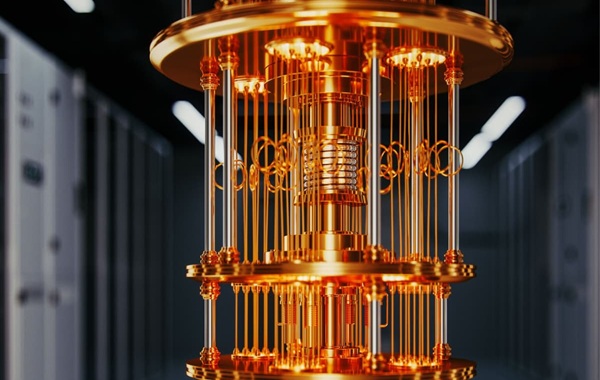
US scientists build new chip to power quantum computers, help in dark matter search
Researchers at the Plasma Science and Fusion Center at the Massachusetts Institute of Technology (MIT) have developed a superconducting diode (SD)–based rectifier that helps deliver direct current (DC) to superconducting classical and quantum computers. The technology can help the search for dark matter in detection circuits operating at research institutes such as CERN.
The rise of technologies such as artificial intelligence (AI) is projected to increase the power consumption of data centers by manifold in the coming years. Contemporary computing is powered by silicon, which can compute large amounts of information but is also not energy-efficient. The semiconductor nature of the components wastes a lot of energy, which is sent out as heat.
Superconducting electronics are a potential alternative to this problem since they can provide high-end computing solutions. However, the systems operate at a mix of ultra-low and ambient temperatures and use a lot of wiring to link these two components together.
If superconducting electronics are to replace semiconductor ones, they need to become more streamlined, something that researchers at MIT have been working on for a while.
Converting AC to DC
For the computing components to work efficiently, circuits must convert input alternating current (AC) to direct current (DC). This is even more important and difficult for semiconducting electronics since this conversion must be achieved at nearly zero temperatures.
For quantum computers, the power supply is crucial since its delivery can cause interference either due to too much heat or electromagnetic noise. Most of this noise comes from many wires connecting ambient temperature components with those working on ultra-cold electronics.
A research team led by Jagadeesh Moodera at MIT’s Plasma Science and Fusion Center addressed this issue by developing a superconducting diode (SD)-based superconducting rectifier that can achieve the AC to DC conversion on a single chip and reduce the number of wires involved.
Building a diode bridge circuit
Moodera and his team have previously worked on SD-based rectifiers made from thin layers of superconducting material. While there has been quite some interest in the approach for a few years now, the work was limited to working with individual SDs.
In their recent work, the researchers successfully integrated four SDs and achieved AC to DC conversion at cryogenic temperatures. This feat can help achieve cleaner operations of quantum systems by reducing thermal and electromagnetic noise traveling through circuit wires.
“Our work opens the door to the arrival of highly energy-efficient, practical superconductivity-based supercomputers in the next few years,” said Moodera in a press release. “Moreover, we expect our research to enhance the qubit stability while boosting the quantum computing program, bringing its realization closer.”
The SDs can also serve as isolators or circulators and assist in insulating qubit signals from external triggers. While this brings the dream of quantum computing closer to reality, it also opens doors for further scientific inquiry.
Superconducting logic circuits also play a crucial role in dark matter detection circuits, such as those deployed at the experiments at CERN and the LUX-ZEPLIN at the Berkeley National Laboratory in the US.
Source: Interesting Engineering
Scientists turn human urine into dental and bone implant material using yeast
US scientists build new chip to power quantum computers, help in dark matter search