The Touching Reason Prehistoric People May Have Collected And Reused Old Tools
Prehistoric sites are full of stone tools that appear to have two life cycles: They’ve been crafted, used, and discarded before being picked up a second time and used again. A new study puts forward an interesting hypothesis as to why this is.
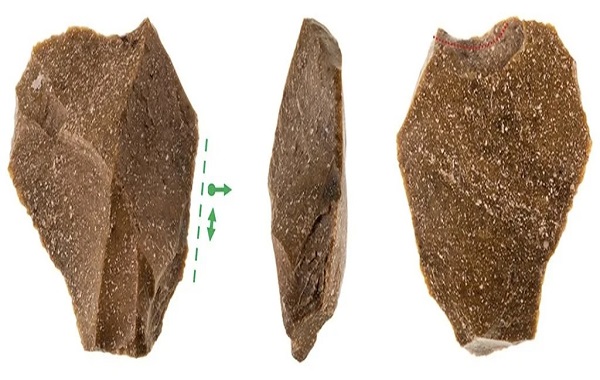
Archaeologists looked at 49 flint tools dug up from the well-known Revadim site in the south of Israel’s Coastal Plain. The examined tools were from a sediment layer dated to about 500,000 years ago.
Through a study of the patina of the objects – that’s the chemical coating that settles on flint when it’s exposed to the open air for a long period of time – the researchers determined the function of these objects across two different life cycles of use.
“Why did prehistoric humans collect and recycle actual tools originally produced, used, and discarded by their predecessors, many years earlier?” says archaeologist Bar Efrati from Tel Aviv University in Israel.
“Scarcity of raw materials was clearly not the reason at Revadim, where good-quality flint is easy to come by. Nor was the motivation merely functional, since the recycled tools were neither unusual in form nor uniquely suitable for any specific use.”
What’s more, the reshaping that took place as these tools were picked up and used a second time looks to have been very minimal.
The scars from their first deployment were largely retained, suggesting that it was important to preserve their appearance.
Based on these clues, researchers think the tools held sentimental value and were collected because of memories they evoked or their specific connections to the past.
It’s difficult to know for sure, but it’s an interesting idea with some evidence to back it up.
“Imagine a prehistoric human walking through the landscape 500,000 years ago, when an old stone tool catches his eye,” says archaeologist Ran Barkai from Tel Aviv University. “The tool means something to him – it carries the memory of his ancestors or evokes a connection to a certain place.”
It is possible these tools were reused because it was less effort than creating new tools from scratch, but alongside the 49 reused objects analyzed here, there were also plenty of newly created tools – so that strategy was extensively used as well. And adapting an old tool is not necessarily easier than creating a new one from scratch.
In other words, these early humans living some 500,000 years ago weren’t all that different from us in how they collected keepsakes – functional keepsakes that did a job, but nevertheless reminders of something that had happened in the past.
“In a modern analogy, the prehistoric human may be likened to a young farmer still plowing his fields with his great-grandfather’s rusty old tractor, replacing parts now and then, but preserving the good old machine as is, because it symbolizes his family’s bond with the land,” says Barkai.
Source: Science Alert
Archaeologists Uncover Thrilling ‘Time Capsule’ of Iron Age Artifacts in England
Archaeologists Uncover Thrilling ‘Time Capsule’ of Iron Age Artifacts in England
The Touching Reason Prehistoric People May Have Collected And Reused Old Tools