
The “Impossible” Twin: JWST Spots a Mature Galaxy That Shouldn’t Exist
Astronomers are stunned by “Alaknanda,” a galaxy mirroring our Milky Way just 1.5 billion years after the Big Bang.
The early Universe was supposed to be a chaotic mess. Standard cosmological models predict that infant galaxies were irregular, blob-like, and unstable. But new images from the James Webb Space Telescope (JWST) have just shattered that timeline.
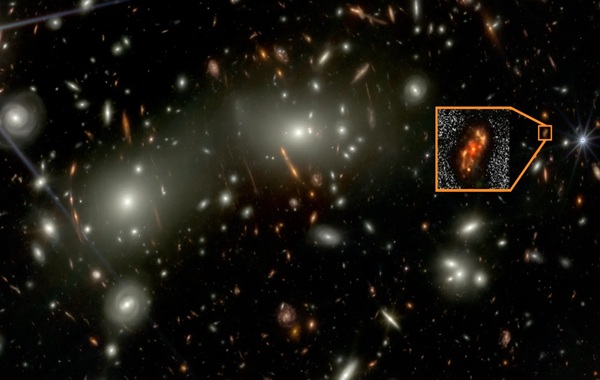
Researchers have identified a grand-design spiral galaxy named Alaknanda that looks shockingly similar to our own Milky Way—but it existed when the Universe was only 10% of its current age.
A Cosmic Rulebreaker
Discovered by researchers Rashi Jain and Yogesh Wadadekar from the NCRA-TIFR in India, Alaknanda defies the rules of cosmic evolution. Located 1.5 billion years after the Big Bang, it possesses a structural maturity that shouldn’t be possible this early in time.
Instead of a chaotic cloud, JWST revealed a stable, rotating disk with sweeping spiral arms and a bright central bulge.
“Alaknanda has the structural maturity we associate with galaxies that are billions of years older,” explains Jain. “It’s forcing us to rethink our theoretical framework.”
Faster, Bright, and Organized What makes Alaknanda truly an anomaly is its ferocious pace of life.
Rapid Growth: It creates stars at a rate of 60 Suns per year—about 20 times faster than today’s Milky Way.
Massive Scale: It spans 30,000 light-years, a size previously thought impossible for such a young spiral.
Ordered Structure: It managed to organize 10 billion solar masses into a neat spiral in just a few hundred million years.
How Did We See It?
To find this cosmic gem, astronomers used a trick of gravity. Alaknanda sits behind the massive Abell 2744 galaxy cluster (also known as Pandora’s Cluster). The cluster acted as a giant magnifying glass—a phenomenon called gravitational lensing—amplifying Alaknanda’s light and allowing JWST’s infrared sensors to peer into its structure with unprecedented detail.
Rewriting History
The discovery of Alaknanda is more than just a pretty picture; it is a pivotal moment for astrophysics. It suggests that the physical processes that sculpt galaxies—gas accretion and density waves—work far more efficiently than our computer simulations predicted.
If the Universe could build a “Milky Way twin” this quickly, the cosmos “grew up” much faster than humanity ever imagined.
Source: science daily
From Nuclear Wasteland to Deep Space: The Mutant Fungus That Could Save Astronauts
The “Impossible” Twin: JWST Spots a Mature Galaxy That Shouldn’t Exist