

The Chamber Egyptologists Ignore: Does Hidden Geometry Rewrite the Purpose of the Great Pyramid?
Beneath the Great Pyramid of Khufu lies one of the most misunderstood spaces in ancient architecture: the subterranean chamber. Often dismissed as an unfinished excavation, this chamber may instead represent the geometric and symbolic foundation of the entire pyramid. Recent geometric interpretations suggest that its form, proportions, and placement were deliberate. Could this hidden chamber reveal the original purpose of the Great Pyramid itself?
Visitors descending nearly thirty meters below the Giza Plateau encounter a rough-hewn cavern that seems abandoned. Yet its very crudeness may be intentional. What if this space was not meant to impress the living, but to serve the eternal journey of the king’s spirit? What if geometry, symbolism, and cosmology converge here, at the pyramid’s lowest point?

The Subterranean Chamber Geometry of the Great Pyramid
Modern archaeology has long viewed the subterranean chamber as a failed design. However, geometry tells a different story. When examined within the pyramid’s vertical system, this chamber aligns precisely with the upper chambers. Together, they form a symbolic ladder from earth to sky.
This vertical arrangement suggests intent, not abandonment. Each chamber appears to correspond to a natural element revered in Heliopolitan theology. Earth, water, air, and sky structured the Egyptian cosmos. The subterranean chamber, carved directly into bedrock, aligns naturally with Geb, the earth god. Stone itself was his domain.
Was this chamber designed as the pyramid’s metaphysical anchor?

Pythagorean Geometry and Mathematical Knowledge in Khufu’s Pyramid
The Great Pyramid encodes mathematical relationships that predate Greek geometry. The well-known relation between the pyramid’s height and perimeter reflects an understanding of circular geometry using the approximation 22/7 for pi.
These principles extend downward. The subterranean chamber reveals additional geometric planning. Its dimensions and internal alignments suggest familiarity with right triangles, squares, and diagonals. Such knowledge challenges the assumption that ancient builders worked only by intuition.
Could this chamber preserve Egypt’s earliest geometric canon?
Earth Symbolism, Square Geometry, and the God Geb
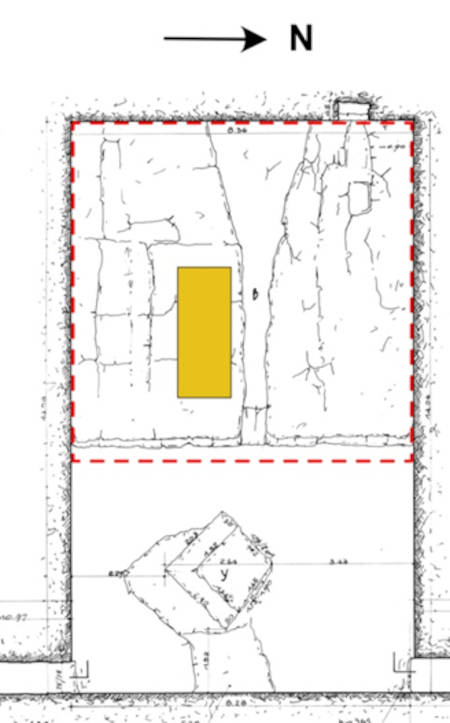
Across cultures, the square symbolizes earth, stability, and material existence. This symbolism likely originated in Egypt. In the subterranean chamber, square geometry dominates the western section, where a massive block of bedrock remains intact.
Survey data shows the chamber’s width measures approximately 16 royal cubits, a square number derived from 4 × 4. The number four reinforces earth symbolism: four sides, four directions, four foundations of stability.
Once identified, the square becomes impossible to ignore. Was this geometry meant to embody the earth god himself?
Water, the Well Shaft, and the Ritual Landscape Below the Pyramid
Ancient accounts describe Khufu buried on an island, surrounded by water beneath the pyramid. At first glance, this seems implausible. Yet the subterranean chamber contains a blind canal, a vertical well, and a depressed floor.
A simple reconstruction reveals how water could have filled the chamber symbolically. A wooden pipe, water poured, and suddenly the king rests on an island. This was not functional engineering. It was ritual staging.
Was the chamber a ceremonial underworld rather than a tomb?

The Number Four and Dimensional Intent in the Subterranean Chamber
Measurements taken by Maragioglio and Rinaldi show that precision was difficult due to rough surfaces. Yet the intended proportions remain visible. The 16-cubit width dominates the design. Vertical sections reveal stacked 4 × 4 cubit squares, suggesting intentional modular planning.
This precision contrasts sharply with the Queen’s Chamber and King’s Chamber, which use different ratios. The subterranean chamber stands apart. It is heavier, darker, and more elemental.
Why would an “unfinished” chamber display such numerical discipline?

Diagonal Geometry, A-Format Proportions, and Divine Balance
The eastern section of the chamber introduces a different geometry. Here, diagonals dominate. When the western square’s width is rotated to form a diagonal, it defines a new square closely matching the eastern space.
This proportion resembles the later A-format rectangle, celebrated by Renaissance architects like Palladio. The diagonal square symbolized harmony between heaven and earth. Circle and square united spirit and matter.
Did Egyptian architects pioneer this concept millennia earlier?

Connecting the Subterranean Chamber to the Queen’s and King’s Chambers
When viewed transparently, the pyramid reveals a striking alignment. An 11-cubit square in the subterranean chamber aligns precisely with the Queen’s Chamber floor and the King’s Chamber wall.
This shared dimension suggests a unified plan. Water symbolism reappears in the Queen’s Chamber. Geometry connects all three levels through the central well.
Was the pyramid designed as a single metaphysical machine?

From Underworld to Sky: The Pyramid as a Spiritual Ascent System
The subterranean chamber appears to serve two purposes. The western square cradled the king’s physical remains within the earth. The eastern, diagonal-defined space facilitated spiritual movement.
The well shaft may have symbolized a portal. Perhaps it connected the underworld to the sun barque’s nightly journey. Perhaps it allowed the king’s spirit to ascend, chamber by chamber, toward the stars.
If so, the subterranean chamber was not abandoned. It was essential.

Final Reflections: Was the Subterranean Chamber the Pyramid’s True Beginning?
The search for earth symbolism, square geometry, and numerical intent within the subterranean chamber proves remarkably successful. Geometry, mythology, and architecture converge in this hidden space.
Rather than a failed experiment, the chamber may represent the pyramid’s starting point. Earth below. Sky above. The king rising between them.
If this chamber was misunderstood for centuries, what else within the Great Pyramid still waits to be decoded?
Source: The Chamber Egyptologists Ignore: Does Hidden Geometry Rewrite the Purpose of the Great Pyramid?
Büyük Üstad Leonardo da Vinci’nin DNA’sının Elde Edilebileceği Açıklandı
Büyük Üstad Leonardo da Vinci’nin DNA’sının Elde Edilebileceği Açıklandı
The Chamber Egyptologists Ignore: Does Hidden Geometry Rewrite the Purpose of the Great Pyramid?