
New imaging tool visualizes cell functions in a microphysiological system
A microphysiological system (MPS), also known as an organ-on-a-chip, is a 3D organ construct using human cells that help reveal how organs respond to drugs and environmental stimuli.
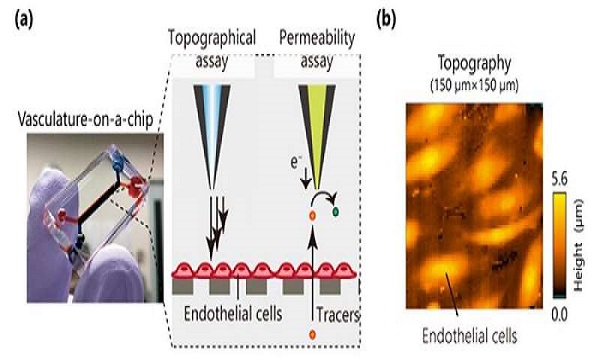
Now, Tohoku University researchers have developed a new analytical method that visualizes cell functions in MPS using scanning probe microscopy (SPM).
SPM differs from optical microscopy since it employs fine probe scanning over a sample surface and then exploits the local interactions between the probe and the surface. The biggest advantage of SPM over conventional microscopy is that physical and chemical conditions can be acquired rapidly and as a high-resolution image.
In this study, SPMs evaluated a vascular model (vasculature-on-a-chip) by scanning electrochemical microscopy (SECM) and scanning ion conductance microscopy (SICM). Using these SPMs, the researchers quantified the permeability and topographical information of the vasculature-on-a-chip.
“MPS shows potential to recapitulate the physiology and functions of their counterparts in the human body. Most research on this topic has focused on the construction of biomimetic organ models. Today, there is an increasing interest in developing sensing systems for MPS” said first author Yuji Nashimoto.
Some have touted electrochemical sensors to monitor MPS. However, most electrochemical sensors cannot acquire the spatial information of cell functions in MPS because they have only one sensor per one analyte. In contrast, SPM provides spatial information about cell functions rapidly.
“Our research group has developed various electrochemical imaging tools, SPMs and electrochemical arrays,” explained corresponding author Hitoshi Shiku.
“These devices will help usher in next-generation sensors in MPS.”
Source:https://onlinelibrary.wiley.com/journal/21922659 http://www.tohoku.ac.jp/en/
‘Seeing’ single cells with sound
If you are a researcher who wants to see how just a few cells in an organism are behaving, it is no simple task. The human body contains approximately 37 trillion cells; the fruit fly flitting around the overripe bananas on your counter might have 50,000 cells. Even Caenorhabditis elegans, a tiny worm commonly used in biological research, can have as many as 3,000 cells. So, how do you monitor a couple of microscopic specks amid all of that?
New imaging tool visualizes/New imaging tool visualizes