
NASA’s Surprising Idea: Can Archaeology Decode Messages from Aliens?
If a genuine extraterrestrial signal ever reaches Earth, the real challenge may not be detection — it may be interpretation. Finding a signal is only the beginning. Understanding what it means could prove far more complex.
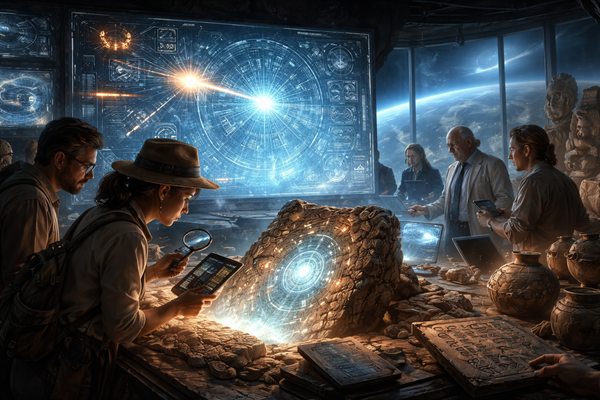
That is the central argument behind a NASA History Series book proposing that archaeology and anthropology — disciplines skilled at interpreting fragmentary traces of lost cultures — could play a crucial role in the Search for Extraterrestrial Intelligence, or SETI.
What makes the story more intriguing is an important update: despite early online claims that NASA had quietly “pulled” the publication after media confusion, the book is now hosted openly on NASA’s own website, complete with official downloads and documentation.
So why would archaeologists, who study ancient civilizations on Earth, help decode a message from another star system? And what does this tell us about humanity’s readiness for contact?
NASA History Series Book on Archaeology and Interstellar Communication
The story first gained traction after an Ancient Origins report titled “NASA Book Explores How Archaeology Could Contribute to Understanding Extraterrestrial Communication.” The article described a NASA volume edited by Douglas A. Vakoch, former Director of Interstellar Message Composition at the SETI Institute.
Rather than making sensational claims, the book draws parallels between deciphering ancient scripts and interpreting possible interstellar messages. NASA’s own framing avoids science-fiction speculation and instead treats extraterrestrial contact as a problem of meaning, culture, and interpretation.
NASA’s official page describes the project as an effort to push SETI beyond a purely technical challenge. Detecting a signal is one thing; determining whether “meaningful communication” is even possible is another.
The volume, titled Archaeology, Anthropology and Interstellar Communication, is a collection of chapters by scholars exploring how human experience with lost civilizations can inform future encounters with non-human intelligence.
SETI Meets Archaeology: Decoding Messages from Lost Civilizations
In the introduction, Vakoch explains why archaeology offers a powerful analogy for SETI:
“As we search for analogies to contact at interstellar distances, archaeology provides some intriguing parallels, given that its practitioners — like successful SETI scientists — are charged with reconstructing long-lost civilizations from potentially fragmentary evidence.”
Archaeologists rarely receive full stories. Instead, they rebuild societies from broken tools, symbols, ruins, and fragments of writing. SETI researchers may face the same situation: a signal arrives, but its cultural content remains opaque.
Anthropologist Ben Finney and historian Jerry Bentley compare extraterrestrial decoding with the interpretation of Egyptian and Mayan hieroglyphs. When scholars first approached Mayan writing, they succeeded by identifying number systems and astronomical calendars based on the Moon and Sun.
Mathematics and astronomy became bridges across time and culture.
As Vakoch notes, math and science may serve as the same universal foundation for interstellar communication. If two civilizations share physics, they may share at least part of a symbolic vocabulary.
But does shared science guarantee shared meaning?
Decoding Alien Messages: Why Archaeology Is NASA’s Analogy
The NASA book argues that SETI may resemble archaeology more than cryptography. An interstellar signal might contain structure, repetition, and complexity — but structure alone does not equal understanding.
Just as archaeologists reconstruct ancient cultures from limited evidence, SETI researchers may be forced to interpret distant intelligence with no shared language, no social context, and no emotional reference points.
The book frames extraterrestrial contact as a reconstruction problem:
Who sent the signal?
Why was it sent?
What assumptions shaped it?
Can meaning survive across cosmic distance and time?
These are not engineering questions. They are anthropological ones.
Rock Art, Cup-and-Ring Marks, and the Limits of Interpretation

One part of the original media frenzy stemmed from misunderstanding. Some outlets implied NASA was claiming ancient rock art was extraterrestrial. That is not what the book says.
Instead, rock art is used as a thought experiment for how humans interpret symbols without context.
In the final chapter, “Constraints on Message Construction for Communication with Extraterrestrial Intelligence,” William H. Edmondson uses prehistoric carvings as an analogy. He points out that thousands of ancient symbols carved into stone still puzzle researchers today.
“We can say little, if anything, about what these patterns signify, why they were cut into rocks, and who created them,” Edmondson writes. “For all intents and purposes, they might have been created by aliens.”
Scotland’s famous cup-and-ring marks illustrate the dilemma. Scholars debate their meaning centuries after discovery. Without cultural memory, symbols become ambiguous.
If human symbols confuse us after only a few thousand years, what happens when the sender is light-years away?
NASA and SETI: Information Is Not Meaning
Archaeologist Kathryn Denning offers a critical warning in the book: complexity does not equal comprehension.
A signal may contain patterns, but patterns alone do not explain intention. Human codebreaking works because humans share biological and cultural assumptions. An extraterrestrial civilization may share neither.
There may never be a Rosetta Stone moment.
Without common reference points, a message could remain mathematically elegant yet culturally silent. SETI, therefore, is not simply about finding intelligence — it is about recognizing whether intelligence can ever be understood.
So the real question becomes: are we searching for signals, or for shared understanding?
NASA Now Hosts the Book Openly on Its Website
One of the most persistent claims online was that NASA had quietly removed the book after confusion in the press.
Whatever occurred during the early reporting wave, the present reality is clear: NASA now hosts the book openly. The official landing page includes multiple formats, and the full PDF is accessible directly from nasa.gov.
NASA also lists the work on its SETI history pages and continues to emphasize astrobiology and technosignatures, even after Congress canceled NASA’s original SETI program in the early nineteen-nineties.
The page itself shows a recent update, reinforcing that NASA’s interest in extraterrestrial intelligence remains active and transparent.
Technosignatures and the New Era of Alien Detection
Modern SETI has evolved. Instead of waiting only for radio messages, NASA now focuses on technosignatures — indirect signs of technology visible in astronomical data.
These include:
Unusual atmospheric gases.
Industrial chemical traces.
Artificial energy patterns.
Non-natural light emissions.
Rather than listening for greetings, scientists look for fingerprints of technology.
Yet even here the problem remains the same: detection is easier than interpretation.
If we see evidence of technology, how do we determine motive, culture, or meaning behind it?
What If We Receive a Signal Tomorrow?
If a message arrived tonight, would we truly understand it?
Would mathematics be enough?
Would symbolism translate across species?
Would intelligence guarantee communication?
NASA’s archaeology-based approach suggests humility. Humanity itself struggles to decode its own ancient voices. Expecting clarity from another civilization may be unrealistic.
Perhaps SETI’s greatest challenge is not finding alien intelligence — but learning how to recognize meaning when it does not look human.
So when the universe finally speaks, will we hear words — or only echoes?
Source: NASA’s Surprising Idea: Can Archaeology Decode Messages from Aliens?
Are We Redefining Habitability? Two New Exoplanets Challenge Everything We Thought We Knew
Are We Redefining Habitability? Two New Exoplanets Challenge Everything We Thought We Knew
NASA’s Surprising Idea: Can Archaeology Decode Messages from Aliens?