
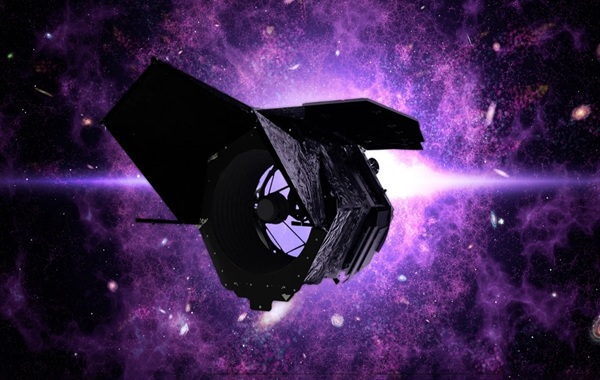
NASA Just Built the Ultimate “Cosmic Scanner”: A Time Machine to Hunt Aliens and Decode the Dark Universe
Beyond Hubble and Webb
We have grown used to the stunning, deep-field images from the Hubble and James Webb space telescopes. They have revolutionized astronomy by acting as precise, narrow spotlights peering back to the dawn of time. But NASA has just finished building a different kind of beast entirely—a machine that doesn’t just look; it scans the cosmos at warp speed.
The Breakthrough: A Quantum Leap in Vision
NASA has officially completed the construction of the Nancy Grace Roman Space Telescope. Forget incremental upgrades; this is a paradigm shift in how we observe reality.
To understand the power of Roman, imagine trying to map an entire ocean using only a magnifying glass. That’s what current telescopes do. Roman, however, is like taking a high-resolution satellite photo of the whole ocean instantly.
Its panoramic field of view is a staggering 100 times greater than Hubble’s. The implications of this speed are mind-bending: surveys that would take Hubble decades to complete, the Roman telescope will finish in a matter of days.
Mission 1: The Ultimate Census of Alien Worlds
Why do we need this speed? To answer the oldest question in human history: “Are we alone?”
Because it can capture so much of the sky so quickly, Roman will perform a cosmic census unlike anything before it. It is expected to discover thousands upon thousands of new exoplanets across our galaxy. By casting such a massive net, it drastically increases the odds of finding Earth-like analogues—rocky worlds in habitable zones that current technology has missed. It is our best shot yet at finding a twin Earth.
Mission 2: Confronting the Invisible Universe Finding alien neighbors is only half the job. Roman is specifically specifically designed to confront the biggest embarrassment in modern science: the fact that 95% of the universe is made of invisible “stuff” we don’t understand.
It will map the precise positions of billions of galaxies over cosmic time to study Dark Matter (the invisible glue holding galaxies together) and Dark Energy (the mysterious force accelerating the expansion of the universe). By seeing the “big picture” of how the universe is structured, Roman aims to finally reveal the physics behind these invisible giants.
What’s Next? The Torture Chamber
The hardware is built, but the journey is just beginning. Before its scheduled launch around May 2027, the telescope must survive grueling tests. NASA engineers will now subject it to intense vibration checks and cryogenic thermal vacuum chambers to simulate the brutal environment of deep space.
If it survives the testing, we aren’t just launching a new telescope; we are launching a new era of understanding our place in the cosmos.
Source: Science Alert
What If Alien Civilizations Reveal Themselves Only at the End?
NASA Just Built the Ultimate “Cosmic Scanner”: A Time Machine to Hunt Aliens and Decode the Dark Universe