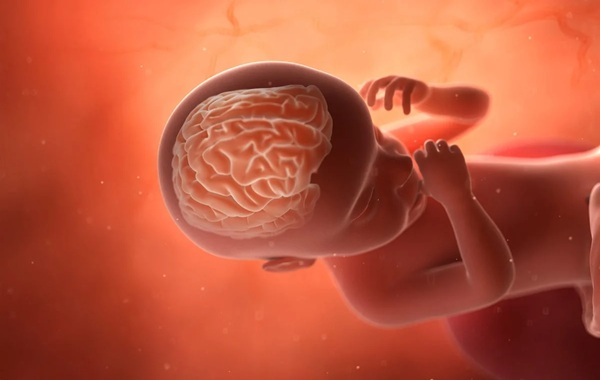
Male and Female Brains Start Developing Differently in the Womb, Scientists Find
Researchers mapped early brain growth from mid-pregnancy to the first month after birth and found signs that sex-linked differences emerge surprisingly early.
For the first time, scientists at the University of Cambridge have tracked human brain growth across a period that is usually studied in pieces: from mid-pregnancy into the first weeks of life. By linking scans taken before and after birth, the team reports that measurable differences in how male and female brains grow can already be seen by mid-pregnancy.
Scientists have long debated when sex-related differences in the human brain first appear and what biological factors drive them. Many studies look either at fetal development or at newborns and infants, which leaves a blind spot right at the moment when the brain is rapidly reorganizing to support life outside the womb. Without a continuous view, it has been difficult to tell whether sex-related differences appear only after birth, or whether they begin earlier and then continue to widen.
To close that gap, researchers at the Autism Research Centre, University of Cambridge, examined brain scans that span both sides of birth, allowing them to model early development as a connected trajectory rather than separate snapshots. The approach matters because brain volume is changing quickly during this window, and small differences can be easier to interpret when you can see the curve of growth over time instead of a single measurement.
The analysis relied on nearly 800 prenatal and postnatal scans from the Developing Human Connectome Project, one of the most extensive perinatal imaging resources assembled. That scale is important in early development research, where individual variation is large and average differences can be subtle.
Yumnah Khan, a PhD student in the Autism Research Centre, who led the study, said: “The human brain undergoes its most rapid and complex development before and shortly after birth. But until now, very little was known about exactly how the brain grows during this formative period of life, and how males and females might differ in this process. Our study has documented the presence of prenatal sex differences in the growth of the human brain.”
Sex Differences in Early Brain Growth
Reporting their findings in the journal Scientific Reports, the researchers found that male brains showed larger increases in overall volume as development progressed. On average, these growth differences were observed across the entire brain when compared with females during the same early stages of life.
Dr Alex Tsompanidis, a Senior Research Associate at the Autism Research Centre, and a member of the research team, said: “This study addresses the age-old question of whether nature plays a role in shaping sex differences in the brain. The findings suggest that prenatal biology sets the stage for such sex differences, even if postnatal experience influences these further.
“The next step is to test if the observed sex differences in human brain growth are driven by prenatal sex steroid hormones, such as testosterone and estrogen. Male fetuses are exposed to much higher levels of these hormones which we know play a role in shaping sex differences in the brain and behaviour in other animals. We need to test if the same is true in humans.”
The research also provided several other important insights into how the brain grows during early development. For example, different brain regions and tissues were found to mature at different rates. White matter – responsible for connecting different brain regions – was found to be the main contributor to brain growth during mid-pregnancy, while grey matter – responsible for cognition and information processing – was found to dominate growth during late pregnancy and after birth.
The researchers also found that early brain development is carefully timed to meet ongoing developmental demands. For instance, subcortical grey matter structures (those deeper within the brain, such as the amygdala, cerebellum, and thalamus) show earlier peak growth rates than cortical grey matter, suggesting that brain systems supporting basic functions mature earlier than those involved in higher-order cognition.
Implications for Neurodevelopmental Conditions
Dr Richard Bethlehem, an Assistant Professor in Neuroinformatics, and a member of the team, said: “Establishing these brain growth trajectories early in life is critical because these may help us understand how differences in early brain development contribute to diverse outcomes, including psychiatric and neurodevelopmental conditions such as autism, which is associated with differences in rates of brain growth.”
Professor Sir Simon Baron-Cohen, Director of the Autism Research Centre, who supervised the study, added: “These findings may help us understand why males and females show differences in the likelihood of neurodivergent outcomes such as autism. For example, the early sex differences in the brain may be due to prenatal sex steroids, and autistic people are exposed to elevated levels of prenatal sex steroid hormones. Future research needs to join the dots in this exciting field of developmental neuroscience.”
Source: SciTechDaily
Deep Ancestry: How Scientists Are Now Studying Life That Existed Before Our First Common Ancestor
Male and Female Brains Start Developing Differently in the Womb, Scientists Find