Is the Milky Way Humming with Hidden Gravitational Waves?
The Gravitational Wave Symphony at the Galactic Center: Will We Ever Hear It Clearly?
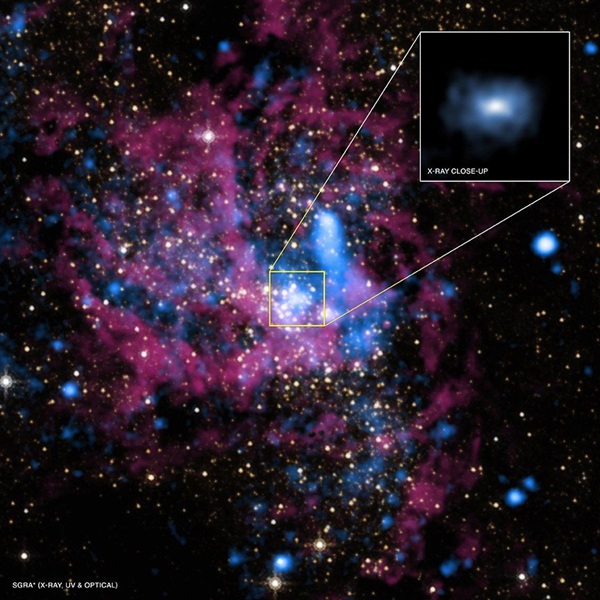
A supermassive black hole lies hidden at the heart of our Milky Way galaxy. Known as Sagittarius A*, it’s surrounded not by silence, but by a complex and ever-changing gravitational chorus. Orbiting this black hole are binary black holes, neutron stars, white dwarfs, and even brown dwarfs—each a potential emitter of gravitational waves. Though these signals are currently beyond our detection capabilities, the next generation of space-based observatories like LISA (Laser Interferometer Space Antenna) could soon let us “listen in” on this cosmic concert.
But will we be able to make sense of what we hear?
Future Gravitational Wave Observatories Like LISA Promise a Longer View
Current instruments such as LIGO and VIRGO only detect the dramatic final “chirps”—the last seconds before two massive objects collide. These are powerful but fleeting moments in the life of binary mergers. LISA, however, will operate in space and be sensitive to lower-frequency gravitational waves, allowing it to detect inspiraling binaries long before their ultimate coalescence.
This extended observation window will be particularly valuable for systems with asymmetrical mass or elliptical orbits, where the gravitational signal rises and falls more noticeably. Tracking these long-duration waveforms will enhance our understanding of gravitational dynamics, orbital evolution, and the populations of compact objects across the galaxy.
A Gravitational Noise Forest in the Milky Way’s Core
But there’s a complication—an astrophysical one that might obscure the very signals we’re hoping to detect.
The galactic center doesn’t just contain merging binaries. It also hosts a dense cluster of compact stellar remnants—including brown dwarfs and neutron stars—that orbit close to the supermassive black hole. These objects produce their own gravitational wave signatures as they interact with the black hole’s intense gravitational field. What results is a veritable gravitational background noise, a forest of overlapping waveforms that could muddy the data.
So what happens when signals from merging binaries are overlaid with the gravitational murmurs from brown dwarfs spiraling around Sagittarius A*? According to a recent study, this overlapping could make it difficult to isolate and analyze individual sources—especially if the merging binaries are less than 10,000 solar masses.
Can We Isolate the Signal from the Gravitational Static?
Despite the apparent chaos, researchers see hope. The key lies in the statistical nature of this background signal. Like a crowded room filled with whispers, the noise has a pattern—one that can be modeled and, potentially, filtered out.
This is where machine learning and signal processing may play a transformative role. Advanced algorithms could be trained to pick out the subtle, telltale fingerprints of unique gravitational events from within the cacophony. By leveraging multi-messenger astronomy—combining gravitational wave data with electromagnetic observations like radio flares from tidally stressed brown dwarfs—astronomers might be able to validate and distinguish overlapping sources with greater precision.
Preparing Now for the Challenges of Tomorrow’s Space Telescopes
Although observatories like LISA won’t launch for another decade or more, the challenges of data filtering, signal isolation, and machine learning-based detection can be tackled today. These tools will be essential to unlocking the rich astrophysical information encoded in these faint cosmic ripples.
It’s no longer just a matter of building better ears to hear the universe. It’s about learning to interpret its layered voices—a blend of inspirals, orbital dances, and deep-space disturbances—that have been resonating in the fabric of spacetime for eons.
Will We Learn to Decode the Gravitational Chorus?
As we push the limits of what gravitational wave astronomy can achieve, one question lingers: Can we separate the song from the noise? Or will the whispers of compact objects and the distant echoes of stellar mergers blend into an undecipherable hum?
The answer will determine not just what we hear—but what we truly understand—about the heart of our galaxy.
Source: Is the Milky Way Humming with Hidden Gravitational Waves?
New framework suggests stars dissolve into neutrons to forge heavy elements
New framework suggests stars dissolve into neutrons to forge heavy elements