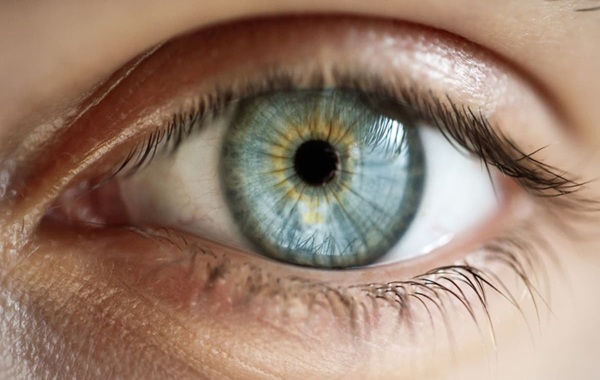
Humans see color never before visible to naked eye with retinal stimulation technique
The colors we perceive have been dictated by the intricate workings of our eyes.
However, a new possibility has emerged: breaking those limits and unlocking a color previously unseen by human eyes.
James Fong and colleagues at the University of California, Berkeley, have developed a new retinal stimulation technique called Oz.
Interestingly, the Oz technique successfully bypassed the “natural limitations” of the retina in a proof-of-concept experiment.
Through the activation of thousands of retinal cone cells, Oz elicited the perception of a “highly saturated blue-green color” — a hue previously unseen by the human eye.
The newly introduced technique could help in addressing visual deficiencies.
“We introduce a new principle, Oz, for displaying color imagery: directly controlling the human eye’s photoreceptor activity via cell-by-cell light delivery,” the team wrote in the study paper.
“Oz represents a new class of experimental platform for vision science and neuroscience, which strives for complete control of the first neural layer to the brain,” it added.
Activating M cone cells
Cones are a type of photoreceptor cell located in the retina of the eye. Their primary function is to enable color vision.
The team states that the current color reproduction technologies operate by manipulating the spectrum of light emitted to stimulate the retinal cone cells in our eyes.
However, a fundamental limitation arises from the fact that these cone cells exhibit an overlap in their sensitivity to different wavelengths and intensities of light.
This overlapping response restricts the range of colors that can be accurately reproduced and ultimately perceived by humans.
Initially, the theoretical basis of Oz suggested the possibility of creating novel colors by bypassing the limitations of natural cone spectral sensitivities, specifically by exclusively activating the M cone cells.
When they tried to specifically activate the M cone cells in the eye, participants perceived a new color that falls outside the spectrum of colors naturally visible to humans.
“Attempting to activate M cones exclusively is shown to elicit a novel color beyond the natural human gamut, formally measured with color matching by human subjects. They describe the color as blue-green of unprecedented saturation,” the study noted.
Technique may help improve color vision
Fong and his team overcame the limitations of traditional color reproduction by employing spatial metamerism.
As per the press release, this technique controls the spatial distribution of light on the retina, instead of the light’s spectrum.
For this, the team developed an Oz laser system that precisely delivered light to individual cells in the eyes of five participants.
This targeted light delivery triggered activity in their M cone cells, resulting in the perception of a “blue-green of unprecedented saturation.”
Interestingly, the Oz system also generated this novel, highly saturated blue-green color in dynamic videos and still images viewed by the participants.
Furthermore, the researchers propose that their innovative approach of precisely controlling photoreceptor activity could have future applications in improving color vision for individuals with color blindness.
Source: Interesting Enigneering
Scientists make neural ‘invisibility cloak’ to treat Parkinson’s disease in rats
Humans see color never before visible to naked eye with retinal stimulation technique