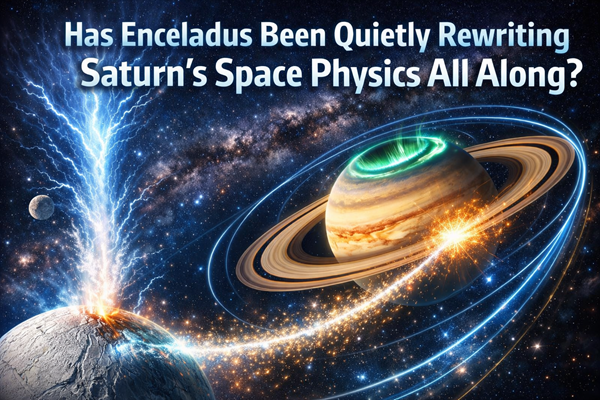
Has Enceladus Been Quietly Rewriting Saturn’s Space Physics All Along?
Saturn’s icy moon Enceladus is small. Its impact is not. New research using more than a decade of data from NASA’s Cassini spacecraft shows that this tiny world drives a giant electromagnetic influence at Saturn, reshaping how energy and momentum circulate across the planet’s vast space environment.
Although Enceladus is only about five hundred kilometers wide, it behaves like a planetary-scale generator. Thanks to its electrically conducting plume atmosphere, the moon creates powerful magnetic disturbances that stretch far beyond its orbit. In effect, Enceladus does not merely orbit Saturn—it talks to it electromagnetically.
So how does a moon so small manage to influence a gas giant on such a massive scale?
Enceladus Electromagnetic Influence at Saturn: A Cassini Breakthrough
An international team led by Lina Hadid from the Laboratoire de Physique de Plasmas analyzed thirteen years of Cassini observations. Data from four instruments were combined to track how magnetic waves connect Enceladus and Saturn.
What was revealed is striking: a lattice-like network of crisscrossing reflected waves trailing behind Enceladus in Saturn’s equatorial plane. However, these structures are not confined there. Instead, they also extend toward Saturn’s far northern and southern latitudes.
As a result, Enceladus is now understood as a central player in Saturn’s magnetospheric circulation system rather than a passive satellite drifting through space.
In other words, energy is not only flowing past Enceladus. It is being generated, redirected, and redistributed by it.
Alfvén Wings and Saturn’s Magnetic Field Connection to Enceladus
The key to Enceladus’s influence lies in structures called Alfvén wings. These are electromagnetic waves that travel along magnetic field lines, much like vibrations moving along a stretched string.
When Enceladus plows through Saturn’s magnetized plasma, it disturbs the field. Consequently, a main Alfvén wing forms and links the moon directly to Saturn’s poles.
Yet the process does not stop there.
The primary wing is reflected repeatedly by Saturn’s ionosphere and by the plasma torus surrounding Enceladus’s orbit. Because of this, a complex system of returning and crossing waves develops. Each reflection strengthens the moon’s ability to distribute momentum and energy throughout Saturn’s magnetosphere.
Therefore, Enceladus acts less like a pebble in a river and more like a generator inside Saturn’s magnetic engine.
Giant Reach: How Enceladus Controls Saturn’s Space Environment
By tracing thirty-six Cassini encounters, researchers detected Alfvén wave signatures far from Enceladus—much farther than expected.
The influence was measured to exceed five hundred four thousand kilometers, which is more than two thousand times the radius of Enceladus itself.
This means that a moon smaller than the United Kingdom affects regions comparable in size to Saturn’s entire magnetosphere.
As Thomas Chust, co-author of the study, explains, Enceladus behaves like a planetary-scale Alfvén wave generator. Even though it is tiny, its electrically conducting atmosphere turns orbital motion into electromagnetic power.
Thus, size alone no longer defines importance in planetary systems.
Plasma Turbulence, Filaments, and Saturn’s Auroras Linked to Enceladus
Beyond the large structures, the team also uncovered fine-scale complexity. Turbulence breaks the main Alfvén wing into thin filaments.
Because of this filamentation, waves can scatter and bounce efficiently off Enceladus’s plasma torus. Then, they climb magnetic field lines toward Saturn’s high-latitude ionosphere.
There, they help trigger auroral emissions connected directly to Enceladus.
So, when Saturn’s polar lights glow, part of their energy may trace back to a moon hundreds of thousands of kilometers away. The auroras are not just planetary features—they are moon-driven signatures written across Saturn’s sky.
Why Enceladus Matters for Jupiter’s Moons and Exoplanet Systems
These findings go beyond Saturn.
If a small icy moon with a conductive atmosphere can reshape a giant planet’s magnetosphere, similar effects should occur elsewhere. Jupiter’s moons, such as Europa and Io, may generate related electromagnetic structures. Even exoplanets orbiting magnetized stars could behave in comparable ways.
Therefore, Enceladus becomes a natural laboratory for understanding how small bodies influence large systems through plasma physics rather than gravity alone.
In addition, future missions—such as ESA’s planned Enceladus orbiter and lander in the 2040s—can directly measure these electromagnetic processes at higher resolution.
The moon is no longer just a place to search for life. It is also a key to decoding space physics across the cosmos.
Tiny Moon, Giant Question: How Far Can Enceladus Really Reach?
Enceladus challenges intuition. It sprays water into space. It conducts electricity. It launches magnetic waves that touch Saturn’s poles. It shapes auroras. And it moves energy across half a million kilometers.
So the question is no longer whether Enceladus matters.
Instead, we must ask:
How many other “small” worlds across the universe are quietly exerting giant electromagnetic control over their planetary systems?
Sources: Has Enceladus Been Quietly Rewriting Saturn’s Space Physics All Along?
What If Coal, Not Intelligence, Determines Who Can Talk Across the Stars?
What If Coal, Not Intelligence, Determines Who Can Talk Across the Stars?
Hadid, L. et al., Journal of Geophysical Research: Space Physics – Cassini observations of Enceladus Alfvén wings.
NASA Cassini Mission Archive – Magnetometer and plasma instrument data.
ESA Science – Saturn magnetosphere and Enceladus plume interactions.
NASA JPL – Enceladus, Saturn system overview and auroral connections.
Has Enceladus Been Quietly Rewriting Saturn’s Space Physics All Along?