
Did a Messenger From Another Star Just Pass Earth Without Us Noticing?
What Secrets Could an Interstellar Comet Be Carrying From an Ancient Star System?
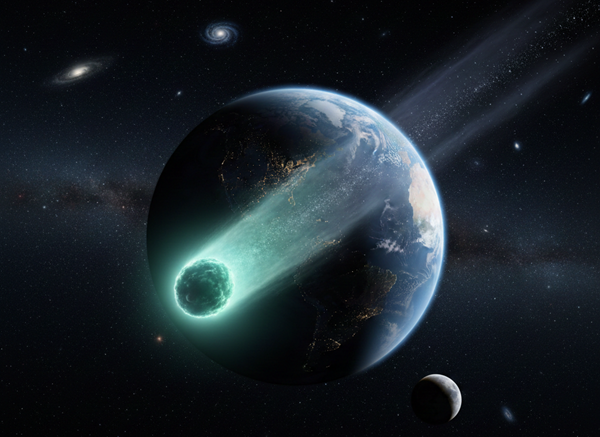
A rare interstellar comet is sweeping through our solar system, offering scientists and skywatchers a fleeting opportunity to observe material from another star system. Known as 3I/Atlas, this cosmic wanderer is making its closest approach to Earth this week before continuing its long journey back toward interstellar space.
Although the comet poses no threat, its visit raises a compelling question: how many such travelers pass unnoticed through our cosmic neighborhood?
Closest Approach of Interstellar Comet 3I/Atlas to Earth
Discovered during the summer, 3I/Atlas will pass within 167 million miles, or 269 million kilometers, of Earth on Friday. This marks the closest point of its passage during its brief tour of the solar system.
While that distance remains vast by human standards, it is close enough for astronomers to track the comet in detail. As a result, researchers are refining their understanding of objects that originate far beyond our Sun’s gravitational reach.
What secrets might this distant visitor be carrying from another stellar birthplace?
NASA Observations and the Fading Light of a Cosmic Visitor
NASA continues to aim its most powerful space telescopes at the comet. Current estimates suggest the icy body measures anywhere between 440 meters and 5.6 kilometers across. However, the comet is already fading as it exits the inner solar system.
Because of this decline in brightness, astronomers say the coming days offer the best chance for backyard observers equipped with telescopes to catch a glimpse of this interstellar object. Each night of observation adds another data point to a rapidly closing window of opportunity.
How often does science get only one chance to observe such a phenomenon?
Interstellar Comet Trajectory: From Earth to Jupiter and Beyond
After its distant encounter with Earth, 3I/Atlas will travel deeper into the outer solar system. In March, it will pass within 33 million miles, or 53 million kilometers, of Jupiter. The giant planet’s gravity will alter the comet’s trajectory once more.
According to Paul Chodas, director of NASA’s Center for Near Earth Object Studies, the comet will not reach true interstellar space again until the mid-2030s. Once it departs, it will never return.
Does this make every observation feel more urgent, knowing there will be no second visit?
Interstellar Objects in the Solar System: A Rare but Growing List
Comet 3I/Atlas represents only the third confirmed interstellar object ever detected passing through our solar system. Unlike familiar comets such as Halley’s, which originate in the icy outskirts of our own system, interstellar comets form around distant stars.
The first confirmed interstellar visitor was detected in 2017 by a telescope in Hawaii. Two years later, a second object was identified by a Crimean amateur astronomer. In July, NASA’s ATLAS telescope in Chile discovered 3I/Atlas while scanning the skies for potentially hazardous asteroids.
Each discovery suggests these objects may be more common than once believed.
The Ancient Origins of Interstellar Comet 3I/Atlas
Scientists suspect that 3I/Atlas may have formed in a star system far older than our own. If true, the comet could predate the Sun by billions of years. This possibility makes it an especially valuable scientific target.
Such ancient objects may preserve clues about the earliest stages of planetary formation across the Milky Way. By studying them, researchers gain insight not only into distant systems, but also into the origins of our own.
Could these silent travelers be carrying the oldest stories in the galaxy?
Source: Did a Messenger From Another Star Just Pass Earth Without Us Noticing?
Could Alien Worlds Host “Xeno-Gels” That Imitate Early Earth Life?
Could Alien Worlds Host “Xeno-Gels” That Imitate Early Earth Life?