
Could Ultraviolet Light Expose the True Origins of Comet 3I/ATLAS
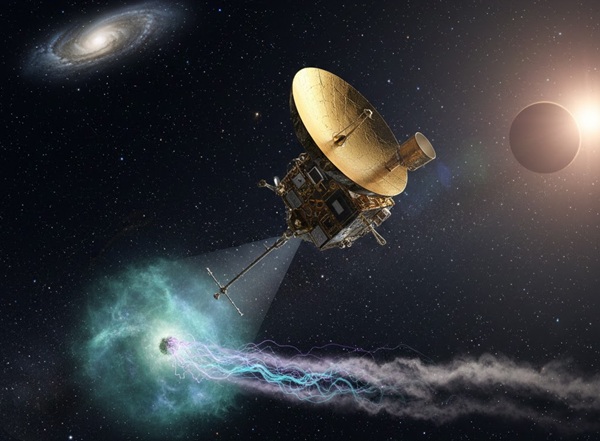
Comet 3I/ATLAS, a confirmed interstellar comet, was observed in ultraviolet light by NASA’s Europa Clipper spacecraft during a critical observational gap. This rare event marks the first time Europa Clipper studied an object originating beyond our solar system. As a result, scientists gained data that could not be captured from Earth or Mars. What can this fleeting visitor tell us about distant star systems?
Europa Clipper Mission and the Discovery of Interstellar Comet 3I/ATLAS
Europa Clipper launched in two thousand twenty-four and will reach Jupiter in two thousand thirty. Its main objective is to study Europa through forty-nine close flybys. However, science rarely follows strict plans. Shortly after the discovery of Comet 3I/ATLAS, mission teams realized the spacecraft was in a perfect viewing position.
Within days, analysts at NASA’s Jet Propulsion Laboratory calculated the comet’s path. Consequently, the Europa Clipper team adjusted observation schedules. This flexibility allowed the mission to capture an interstellar object unexpectedly. How often does such a coincidence occur in deep-space exploration?
Why Europa Clipper Had a Unique View of Comet 3I/ATLAS
During November, Earth-based telescopes could not observe the comet due to the Sun’s position. Earlier, Mars-based observations had already peaked. Therefore, Europa Clipper filled a critical gap. Its position between the Sun and the comet created a rare sunward viewing angle.
As a result, the Ultraviolet Spectrograph observed the comet from behind its tails. This perspective is extremely uncommon. It allowed scientists to study both the dust tail and the plasma tail simultaneously. Could this angle change how comet tails are interpreted?
Ultraviolet Spectrograph Data Reveals Active Outgassing
The Europa-UVS instrument detected hydrogen, oxygen, and dust-related features. These signals indicate strong outgassing shortly after the comet’s closest approach to the Sun. In addition, the data show water molecules breaking apart into their atomic components.
Because UVS specializes in fundamental atomic transitions, it provides precise measurements. Therefore, scientists can track how gases escape from the nucleus. What does this chemical activity reveal about the comet’s internal structure?
Comparing Observations from Europa Clipper and JUICE
At the same time, ESA’s Jupiter Icy Moons Explorer, or JUICE, observed Comet 3I/ATLAS from an anti-sunward angle. This contrast is important. While Europa Clipper viewed the comet from behind, JUICE saw it from the opposite side.
Together, these datasets offer a more complete three-dimensional view. Consequently, researchers can better understand tail geometry and particle flow. Will combined spacecraft observations become standard for future interstellar visitors?
What Comet 3I/ATLAS Reveals About Its Origin Beyond the Solar System
Understanding gas emission rates helps scientists infer the comet’s birthplace. These measurements suggest how the object formed and evolved before entering our solar system. Moreover, they allow comparisons with comets native to our own planetary neighborhood.
Were similar chemical processes active around other stars? Or did this comet form under entirely different conditions? These questions drive ongoing analysis.
Why Interstellar Comet Observations Matter for Planetary Science
Comet 3I/ATLAS is more than a rare object. It is a physical sample of another star system passing through ours. Europa Clipper’s unexpected observation demonstrates the value of adaptable missions.
As more interstellar objects are discovered, preparedness will be critical. The next visitor may arrive without warning. Will we be ready to observe it in time?
Source: Could Ultraviolet Light Expose the True Origins of Comet 3I/ATLAS?
Uzaylı Medeniyetler Kendilerini Ancak Yok Olurken mi Gösterir?
Uzaylı Medeniyetler Kendilerini Ancak Yok Olurken mi Gösterir?
Could Ultraviolet Light Expose the True Origins of Comet 3I/ATLAS?