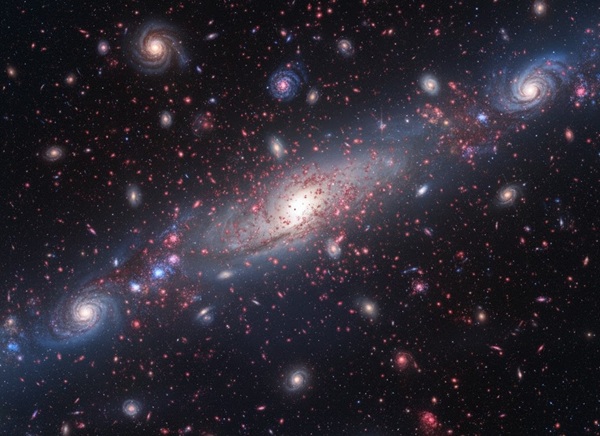
Could Little Red Dots Rewrite Everything We Know About Cosmic Evolution?
JWST’s Breakthrough in Understanding “Little Red Dots”: A New Clue to Early Supermassive Black Hole Growth
The James Webb Space Telescope (JWST) has transformed our view of the early Universe, revealing mysterious compact galaxies known as Little Red Dots (LRDs). Their reddish glow is the result of billions of years of cosmic expansion stretching their light into the infrared. While JWST first detected them at the edge of its observational limits, the mystery of what LRDs truly are has only deepened. Are these objects primitive galaxies, unusual black hole hosts, or something else entirely?
Scientists around the world began dissecting JWST’s early data, searching for clues. One dominant hypothesis emerged: LRDs may be primordial galaxies hosting actively growing supermassive black holes (SMBHs). This idea is striking because such enormous black holes shouldn’t exist so soon after the Big Bang—at least, not according to current theoretical models. Even more puzzling, these LRDs don’t behave like typical active galactic nuclei (AGN). For example, they fail to emit x-rays, which are usually a defining signature of feeding black holes.
If LRDs truly contain massive black holes, why do they look and act so unlike normal AGN? And what does that imply for the earliest stages of cosmic evolution?
Extreme Black Hole Growth in the First 500 Million Years: New Evidence from JWST
A new study published in Nature Communications, titled “Extreme properties of a compact and massive accreting black hole host in the first 500 Myr,” presents the clearest evidence yet that at least one LRD is powered by a rapidly growing SMBH. The research, led by Roberta Tripodi of the University of Ljubljana and the Institute for Fundamental Physics of the Universe, focuses on a galaxy known as CANUCS-LRD-z8.6.
This galaxy appears as it was just five hundred seventy million years after the Big Bang—an astonishingly early period for such an extreme object to exist. JWST’s NIRSpec instrument detected hallmark features of a feeding black hole: broad emission lines created by fast-moving gas near the event horizon, and high-ionization spectral lines produced by intense radiation in extreme environments.
Tripodi explains, “Not only is this galaxy hosting a supermassive black hole, but the black hole is growing rapidly—far faster than expected for such an early epoch.” Such growth challenges long-held assumptions about how early black holes form and evolve. How could a black hole reach such mass so quickly? Could unknown mechanisms or exotic “black hole seeds” be responsible?
Key Observational Clues: Broad Lines, High Ionization, and Shockingly Low Metallicity
Among all high-redshift galaxies studied so far, CANUCS-LRD-z8.6 is unique. It is the only system known at this distance showing both broad-line emission and high-ionization features—unmistakable markers of an accreting SMBH.
These signals are paired with another important observation: the galaxy’s low metallicity, indicating it is in a very early stage of development. With few heavy elements to obscure its internal structure, the intense radiation of the AGN becomes easier to identify.
Co-author Dr. Nicholas Martis emphasizes how essential JWST was for this breakthrough: “The spectral features Webb revealed could not have been detected with previous telescopes.” Even more compelling is the fact that the black hole is massive compared to the galaxy itself, suggesting that in the early Universe, black holes may have grown faster than the stars surrounding them.
Could early SMBHs have undergone extreme episodes of super-Eddington accretion, or formed from unusually large “seeds” left behind by exotic stellar populations? The answers remain uncertain.
A Novel Physical Model: Obscured Stars, a Cleared Sight-Line, and a Patchy Dust Torus
To explain the conflicting observations—an unobscured AGN but obscured stellar light—the researchers developed a physical model of the galaxy.
They propose that:
Our line of sight to the AGN is relatively clear, either due to feedback clearing through dust or a patchy torus.
Most starlight is heavily obscured because stars remain embedded in their birth clouds.
Even small amounts of dust cause significant dimming due to the galaxy’s extreme compactness.
This scenario describes a system undergoing intense star formation while simultaneously feeding a rapidly growing SMBH. The result is a galaxy unlike anything observed at similar distances: compact, massive, and already hosting a black hole of roughly one hundred million solar masses.
Could such systems represent transitional objects on the pathway to forming the ultra-bright quasars observed at redshift six?
A Potential Missing Link: From Little Red Dots to Early Quasars
One interpretation is that CANUCS-LRD-z8.6 may be more evolved than other LRDs and on its way to becoming a quasar. If so, LRDs could represent a critical intermediate stage in the co-evolution of early galaxies and their black holes.
Prof. Maruša Bradač, leader of the research group, notes that the discovery raises fundamental questions: How did such massive black holes emerge so early? What processes accelerated their growth? And how many more of these rapidly evolving objects are still hidden in JWST’s data?
The galaxy’s extreme properties provide valuable constraints for simulations seeking to model SMBH growth in the first billion years of cosmic history. As the authors write, objects like this help limit the range of possibilities for theorists attempting to explain early structure formation.
What Comes Next? ALMA, JWST, and the Hunt for Ancient Black Hole Seeds
The team plans to follow up with observations using both JWST and the Atacama Large Millimeter/submillimeter Array (ALMA). ALMA can detect cold gas within the galaxy, revealing how much fuel the SMBH and star-forming regions still possess. These data may refine our understanding of how fast—and how efficiently—the black hole is growing.
Meanwhile, other research teams are expected to join the hunt for similar systems. Each new LRD discovered will either strengthen or challenge the emerging picture. Could LRDs be the missing evolutionary link between early black hole seeds and the luminous quasars that appear only a few hundred million years later?
And perhaps the most pressing question of all: What unknown mechanisms allowed black holes to grow so rapidly in the early Universe?
Source: Could Little Red Dots Rewrite Everything We Know About Cosmic Evolution?
Why Do Andromeda’s Satellites Live Completely Different Lives Than Ours?
Why Do Andromeda’s Satellites Live Completely Different Lives Than Ours?
Could Little Red Dots Rewrite Everything We Know About Cosmic Evolution?