Cosmic Giant Unveiled: Hubble Discovers a Record-Breaking ‘Planet Nursery’ 40 Times Larger Than Our Solar System
Deep in the cosmos, about 1,000 light-years away, a monster is lurking—and it is hungry for worlds. Astronomers using the Hubble Space Telescope have just captured a stunning view of a protoplanetary disk so vast it defies conventional scale, stretching across nearly 400 billion miles of space.
The Rise of “Dracula’s Chivito”
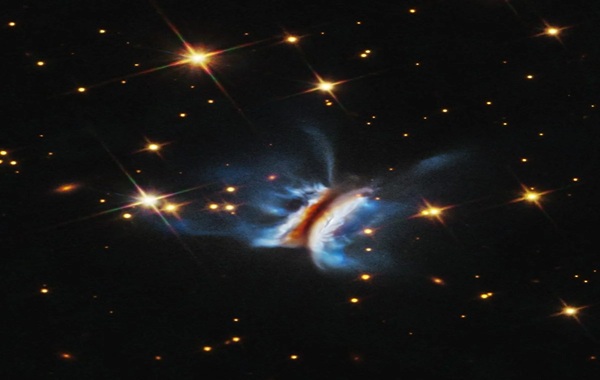
Nicknamed “Dracula’s Chivito”—a nod to both its sandwich-like appearance and its dark, mysterious nature—this object is the largest planet-forming disk ever observed in visible light. To put its size into perspective, it is 40 times wider than our entire solar system. If our solar system were a marble, this disk would be a massive stadium.
Seen edge-on, the disk appears as a dark, dense silhouette against a glowing backdrop, hiding a massive young star at its core. It looks like a cosmic sandwich of gas and dust, with wispy “fillings” reaching far into the void.
A Chaotic Laboratory of Creation
What makes this discovery truly groundbreaking isn’t just its size, but its violence. Unlike the neat, orderly rings often seen in textbook illustrations, “Dracula’s Chivito” is a scene of pure celestial chaos.
Hubble’s high-resolution eyes revealed:
Strange Asymmetry: One side of the disk features towering filaments of material, while the other remains sharp and contained.
Turbulent Streamers: Vast plumes of dust and gas are being thrown high above and below the disk plane, suggesting a highly unstable environment.
Planet-Building Potential: With a mass estimated at 10 to 30 times that of Jupiter, this disk contains enough “raw material” to build an entire army of gas giant planets.
Rewriting the Rules of Planetary Birth
“These new Hubble images show that planet nurseries can be much more active and chaotic than we ever expected,” says lead author Kristina Monsch. This discovery challenges our current models of how planetary systems are born. We are seeing a “scaled-up” version of our own early history—but one that is far more extreme and unpredictable.
This giant disk provides scientists with a unique laboratory to study the birth of planets under intense conditions. As we peer into these wispy upper layers, we aren’t just looking at dust; we are witnessing the messy, beautiful, and violent process of worlds being forged from the dark.
The Next Frontier
With the help of both Hubble and the James Webb Space Telescope, astronomers are now racing to understand what causes such massive asymmetry. Is there a hidden companion star? Or are we seeing the immediate aftermath of a cosmic collision? One thing is certain: the “dark matter” of planetary formation is finally coming into the light.
Source: SciTechDaily
Did Astronomers Just Open a New Window Into Space-Time at the Galactic Center?
Cosmic Giant Unveiled: Hubble Discovers a Record-Breaking ‘Planet Nursery’ 40 Times Larger Than Our Solar System