

China’s radar with 5,900 miles range detects plasma bubbles over Giza pyramids
Chinese scientists detected plasma bubbles over the Egyptian pyramids and Midway Islands using the LARID radar in Hainan.
Equatorial plasma bubbles are unusual weather events in low-latitude areas, caused by a sudden loss of charged particles in the ionosphere, a layer of Earth’s upper atmosphere.
These bubbles, which can grow hundreds of kilometers wide, disrupt GPS signals and interfere with satellite communications., the South China Morning Post reported.
Using the LARID, a low-latitude long-range ionospheric radar built last year, China has become the first country to detect plasma bubbles on radar.
On August 27, the Institute of Geology and Geophysics, part of the Chinese Academy of Sciences, shared the results of the largest plasma bubble detection recorded so far on its website.
Radar captures real-time movement of plasma bubbles triggered by solar storm
Plasma bubbles caused by a solar storm were clearly visible on China’s radar from November 4-6 last year, with the farthest echoes detected from North Africa and the central Pacific. By analyzing these signals, scientists were able to observe the detailed formation of the bubbles and track their movement in real-time.
Situated on Hainan Island at the southern tip of the Chinese mainland, the massive LARID radar has a detection range of 9,600km (5,965 miles)—roughly the distance from Hawaii to its east or Libya to its west.
Conventional radars struggle to detect targets below the horizon due to Earth’s curvature. LARID overcomes this by emitting high-power electromagnetic waves that bounce between the ionosphere and the ground, allowing it to cover extensive distances.
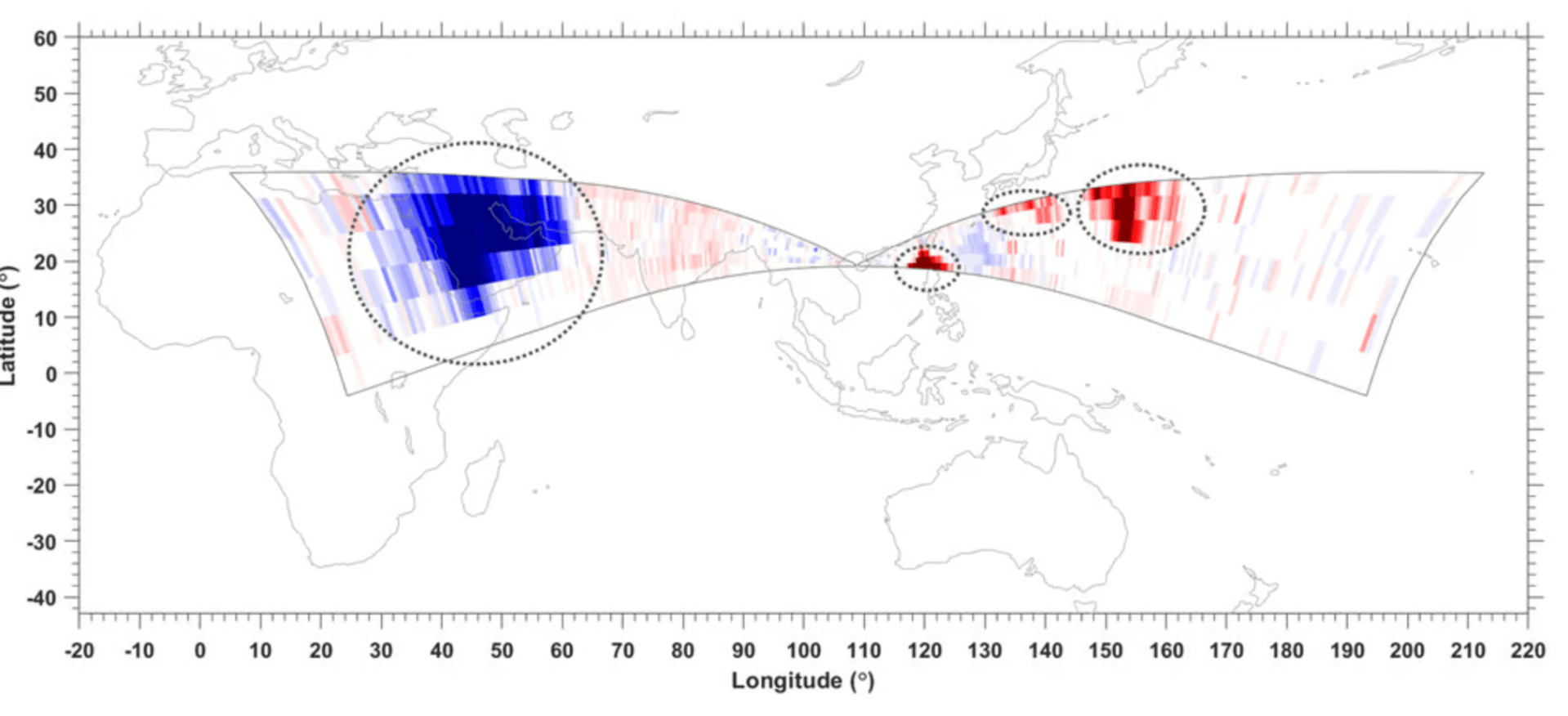
When these waves encounter plasma bubbles, some of the signal is reflected back and captured by LARID’s antenna array. Operating in the 8-22MHz frequency band, LARID has two radar subsystems, one facing east and one west, each with 24 transceiver antennas.
The radar uses a fully digital phased array system, enabling real-time adjustments to detection frequency, range, scanning area, and radar settings as needed.
LARID’s detection range triples in under six months
Initially, LARID’s detection range was 3,000km. However, with operational experience and advanced technologies like new signal coding and geophysical simulation models, its performance has rapidly improved. Within six months, the maximum detection range has increased threefold.
Chinese scientists have proposed building three to four additional over-the-horizon radars similar to LARID in low-latitude regions worldwide to create a network for continuous real-time monitoring of equatorial plasma bubbles.
Due to its low resolution, LARID is not suited for detecting military targets like aircraft or warships. However, according to official Chinese media reports, the Chinese military has widely deployed over-the-horizon radars with similar technologies, which have successfully detected targets including F-22 stealth fighter jets.
Additionally, New PLA warships, including the 055-type destroyers, feature radars that can detect stealth aircraft by using wavelengths that penetrate stealth coatings, potentially achieving detection ranges of hundreds of kilometers.
Source: Interesting Engineering
China’s radar with 5,900 miles range detects plasma bubbles over Giza pyramids