
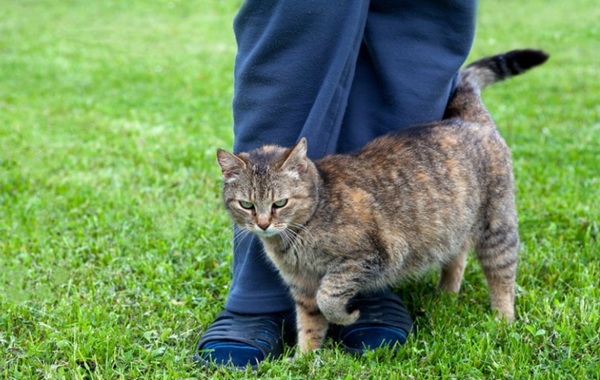
Cats adjust their communication strategy by meowing more when greeting men
As many cat owners will testify, their pets are often mysterious creatures, independent, cunning and sometimes aloof. And now it appears that when it comes to communication, they might be playing favorites. A new study published in the journal Ethology has revealed that domestic cats meow more frequently when male caregivers walk through the front door.
Much of our knowledge of human-cat greetings was based on owners simply telling researchers what their cats did, rather than on rigorous scientific analysis. To better understand these cross-species interactions, scientists led by Yasemin Salgirli Demirbas from Ankara University studied 31 cats and their primary caregivers in the home environment.
The caregivers were asked to use a chest-mounted camera (like a cellphone or GoPro) to film the first few minutes of returning home while behaving as naturally as possible. The team then analyzed just the first 100 seconds of each recording, tracking 22 specific behaviors. These included the number of meows, head-rubbing against the leg and stress-related behaviors like yawning.
Meowing more for men
After analyzing hundreds of clips, one thing stood out clearly: cats vocalized more frequently (meows, purrs, chirps) when greeting male caregivers than when greeting female caregivers. This increased frequency was the same across the board, regardless of the cat’s age, breed, sex, or even the size of the household. On average, cats produced 4.3 meows in the first 100 seconds of greeting men compared to just 1.8 with women.
The researchers propose a compelling reason for this. They suggest that because male caregivers tend to talk less to their cats and are generally less attentive, the cats adjust their communication to get their attention.
As the study authors comment, “Cats used vocal communication more frequently when greeting male caregivers… male caregivers might engage less frequently in verbal behaviors compared to female caregivers. This difference could prompt cats to use vocal signals more actively to elicit responses from male caregivers.”
Complex greeting
The study also found that cats use several forms of communication when greeting their owners. They adopt friendly social behaviors (tail-up posture, approaching and rubbing against the person) and coping behaviors (yawning, stretching, scratching). The researchers interpret this as evidence that when a cat says hello, it is a complex form of communication that includes a desire for connection as well as a way to manage stress, such as relief now that the caregiver is home.
These findings offer a fascinating window into cat communication and behavior. However, the research was conducted only in Turkey, and the sample size was small. Further studies across different countries and cultures are needed to confirm if these gender-based differences in meowing are truly universal.
Source: phys.org
The 600-Million-Year-Old “Smoking Gun”: MIT Just Proved We All Started as… Sponges?
Cats adjust their communication strategy by meowing more when greeting men