Can Space Mutations Defeat Superbugs That Earth Medicine Can’t?
If humanity is to expand permanently into space, curiosity alone will not be enough. Throughout history, exploration has only become sustainable when it produced real economic and practical value. Today, an unexpected possibility is emerging from biology: using space-based evolution to fight antibiotic resistance.
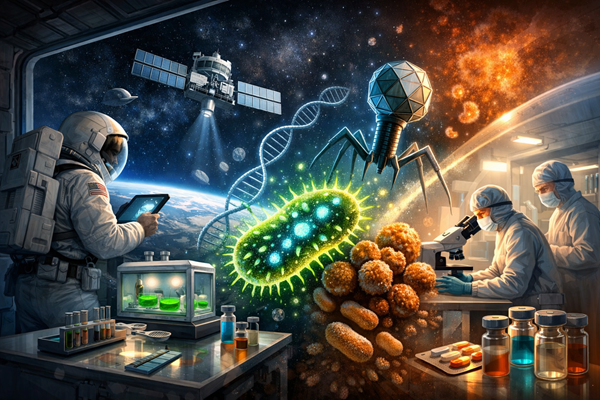
A study led by Srivatsan Raman at the University of Wisconsin–Madison, published in PLOS Biology, suggests that the extreme environment of space can reshape viruses into powerful tools against drug-resistant bacteria. Instead of mining asteroids, one day humanity may mine orbit itself — for evolution. But can mutations formed in space really help solve one of modern medicine’s greatest crises?
Why Antibiotic Resistance Has Become Critical
Antibiotic resistance is increasing faster than new drugs can be developed. Superbugs already cause hundreds of thousands of deaths each year worldwide. Urinary tract infections, in particular, now represent one of the largest classes of drug-resistant diseases.
On Earth, laboratory evolution happens under predictable conditions. Space changes those rules. Microgravity, radiation, the absence of convection, and chemical stress create environments that cannot be fully replicated on our planet. This raises an important question: could space mutations produce biological solutions that Earth evolution never discovers?
The Experiment Begins on the International Space Station
In September 2020, researchers partnered with Rhodium Scientific to launch an evolutionary experiment to the International Space Station. Special cryogenic vials, maintained at –80°C, carried 1,660 genetically diverse bacteriophage variants along with populations of E. coli bacteria. An identical experiment was run simultaneously on Earth.
The same biology evolved under two radically different environments, and the differences were immediate.
Microgravity Slows the Battle
On Earth, bacteriophages typically destroy bacteria within two to four hours. In space, the process slowed dramatically. Microgravity removes natural fluid motion. Without convection, viruses reach bacteria only by slow diffusion. Waste accumulates, and nutrients do not circulate normally.
This stagnant battlefield stresses both predator and prey. Yet biological stress often accelerates innovation.
How Bacteria Adapted in Orbit
Under microgravity, E. coli experienced chemical and nutritional pressure. To survive, the bacteria mutated a gene called mlaA. Normally, this gene regulates phospholipid transport in the cell membrane. Space-induced mutations caused these lipids to flip outward onto the cell surface.
That change reshaped the bacterial armor. Because bacteriophages attach to surface structures, their usual attack strategy stopped working. As a result, the viruses themselves had to evolve.
Smarter Viruses Born in Space
On Earth, phages often evolve simple electrostatic tricks, such as positively charged tips that grip negatively charged bacterial surfaces. In orbit, this approach failed. Instead, space-evolved phages developed hydrophobic substitutions in their receptor-binding proteins.
These changes likely made viral tail fibers more flexible, more stable, and better suited to bind abnormal bacterial membranes. In effect, space forced viruses to invent a new attachment logic that Earth never selected for.
When Space-Evolved Phages Returned to Earth
After the experiment, researchers tested the space-grown phages against real pathogenic bacteria. The results were striking. Phages evolved in orbit were highly effective at killing multidrug-resistant bacteria responsible for urinary tract infections. The Earth-grown phages could not achieve the same performance.
Scientists suspect this is because the human urinary tract creates conditions similar to space: chemical stress, limited nutrients, and unstable membranes. Bacteria inside the body resemble bacteria in orbit more than bacteria in comfortable laboratory dishes. Space evolution, unintentionally, trained viruses for real medical environments.
Could Space Bioreactors Be the Future?
If space can reliably generate therapies superior to those evolved on Earth, orbit may become a biological manufacturing platform. In the future, we could see:
Continuous evolution of medical treatments in space,
Customized bacteriophages for resistant infections,
Targeted solutions for antibiotic-resistant diseases.
Significant challenges remain, including cost, scaling, transport, safety, and regulation. However, history shows that when biology and economics intersect, infrastructure tends to follow.
The Bigger Question
This research reveals more than a clever medical strategy. It demonstrates that evolution behaves differently when gravity disappears. Long-time biological enemies — bacteria and viruses — interact in new ways in orbit and discover strategies Earth never teaches them.
Antibiotic resistance may be only the beginning. Cancer therapies, immune treatments, and cellular engineering could evolve differently in microgravity.
Space may not only expand humanity’s territory. It may expand evolution itself — and provide tools Earth alone could never invent.
Source: Can Space Mutations Defeat Superbugs That Earth Medicine Can’t?