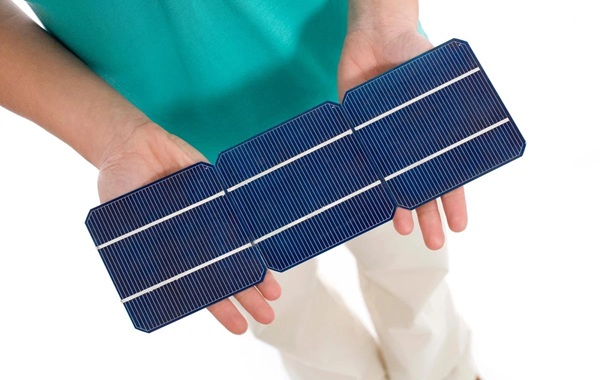
Beyond 100%: The Solar Revolution That Just Shattered Physics’ “Absolute” Limit
The era of “limited” solar energy is officially over.
For decades, scientists operated under a frustrating rule of physics known as the Shockley–Queisser limit. It suggested that a single-junction solar cell could never capture more than about 33% of the sunlight hitting it, while a theoretical 100% efficiency was seen as an unreachable ghost. But a team of researchers from Kyushu University (Japan) and JGU Mainz (Germany) just proved the world wrong.
How did they break the “unbreakable” rule?
Traditional solar cells work like a 1-to-1 relay race: one photon (light particle) creates one exciton (energy carrier). The problem? High-energy blue light often wastes its “extra” power as heat.
The researchers utilized a “dream technology” called Singlet Fission (SF). Think of it as an energy multiplier. By using a specialized molybdenum-based “spin-flip” emitter, they managed to split a single high-energy photon into two energy carriers.
The Result: 130% Efficiency
In their groundbreaking experiments, the team achieved a quantum yield of 130%. This means that for every 100 photons the system absorbed, it generated 130 energy-carrying units. They didn’t just reach the ceiling; they smashed right through it.
Why This Matters for You
This isn’t just a lab curiosity. This breakthrough paves the way for:
Ultra-powerful Solar Panels: Smaller panels producing significantly more electricity.
Next-Gen Electronics: Better LEDs and quantum computing components.
Climate Solutions: A much faster transition to 100% renewable energy by squeezing every possible drop of power from the Sun.
While still in the proof-of-concept stage, the “spin-flip” method has turned the solar industry on its head. The sun delivers enough energy to Earth every second to power the world for a year—and we just found a much bigger bucket to catch it in.
Source: SciTechDaily
This Spinning Device Could Turn Ocean Waves Into Endless Clean Energy
Beyond 100%: The Solar Revolution That Just Shattered Physics’ “Absolute” Limit