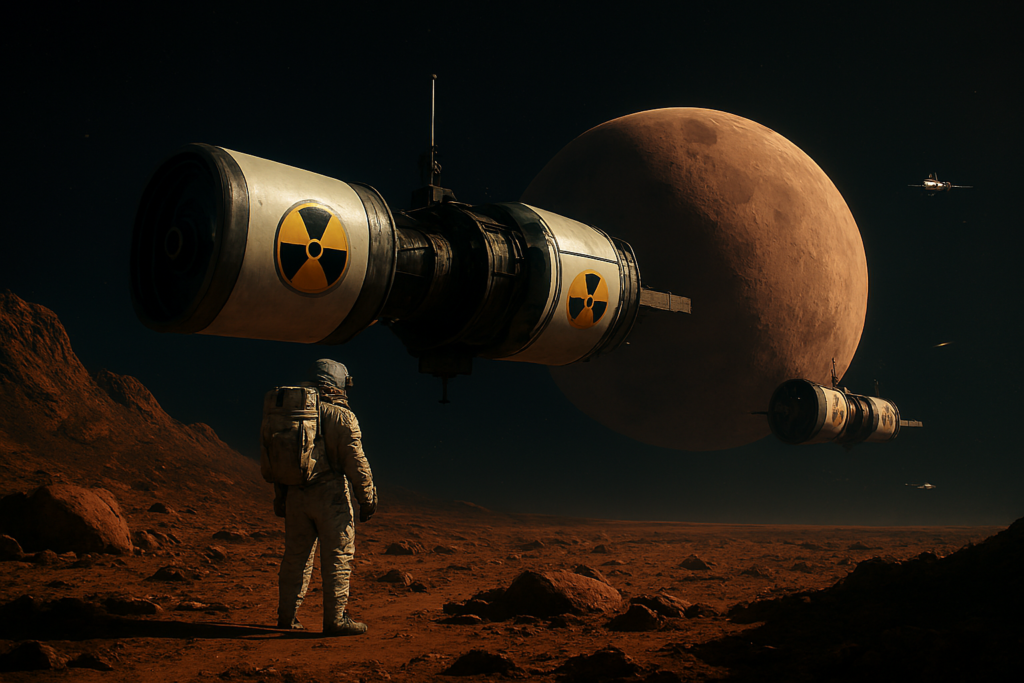
Are We Ready for a Nuclear-Powered Civilization Beyond Earth?
Energy dominance is no longer only a terrestrial ambition. It is rapidly becoming a space imperative. Researchers have long linked unreliable energy to poor physical health, mental stress, and higher mortality. However, when humans leave Earth, energy is not merely about comfort. It becomes a matter of survival.
As astronauts push deeper into the solar system, dependable power will decide whether missions succeed or fail. Because of that, nuclear science and space technology are being positioned as the backbone of future exploration. The question is no longer if nuclear energy belongs in space, but how fast it can be deployed to secure U.S. leadership beyond Earth.
So, how can the United States achieve true energy dominance in space?
Why Space Energy Dominance Depends on Nuclear Power Systems
Since the nineteen-sixties, spacecraft such as Voyager One, Voyager Two, and Mars rovers have relied on radioisotope power systems. These devices convert the heat from plutonium decay into electricity. They operate for decades without sunlight.
However, radioisotopes only deliver limited power.
For long-term settlements on the Moon or Mars, something stronger is required. Therefore, NASA is moving toward fission surface power reactors. In fact, the agency plans to deploy a nuclear reactor on the Moon by fiscal year two thousand thirty.
Unlike solar panels, nuclear reactors are not affected by dust storms, long lunar nights, or distance from the Sun. Consequently, they offer a stable, scalable energy supply for habitats, science stations, mining operations, and propulsion systems.
Sebastian Corbisiero, Department of Energy Space Reactor Initiative Director, explains:
“It might sound like science fiction, but it’s not. Fission reactors provide a step increase in available power. What we need now is a clear path forward.”
So, nuclear energy is no longer optional. It is becoming foundational.
Space Nuclear Reactor Engineering Challenges for Energy Dominance
Although Earth-based reactors provide a template, space reactors face unique obstacles. In space, three variables dominate design:
Mass
Temperature
Endurance
First, mass becomes critical. Everything must ride on a rocket. Therefore, reactors must be light yet extremely strong. For example, water is rarely ideal as a coolant in space because it requires thick, heavy pressure vessels.
Second, temperature constraints grow extreme. Space reactors operate at higher thermal levels to maximize efficiency. As a result, materials used in terrestrial reactors may fail in orbit or on lunar soil.
Third, maintenance becomes impossible. On Earth, reactors are shut down every eighteen to twenty-four months. In space, systems must operate autonomously for up to ten years without repair.
Therefore, electronics, fuel, and mechanical parts must survive radiation, vacuum, micrometeoroids, and temperature swings.
Because of these limits, NASA’s Fission Surface Power program is redesigning nuclear technology specifically for extraterrestrial environments.
US Space Nuclear Leadership and Energy Dominance Strategy Options
The United States has explored space nuclear power since the Cold War. Early systems like SNAP-Ten-A proved reactors could operate in orbit. Today, however, competition and geopolitical pressure demand faster progress.
A major report titled “Weighing the Future: Strategic Options for U.S. Space Nuclear Leadership” outlines three strategic approaches.
Each one targets energy dominance in space, but with different risk and investment levels.
Go Big or Go Home: Large-Scale Space Nuclear Power Deployment
This strategy proposes building a one hundred to five hundred kilowatt electric reactor system led by NASA or the Department of Defense, with Department of Energy support.
The goal is speed and scale.
If successful, this approach could immediately transform lunar and Martian infrastructure. Large reactors could power habitats, industrial systems, and deep-space propulsion.
However, the challenge is funding and leadership continuity. Without strong political backing, such a project could stall.
Still, its payoff is enormous.
Chessmaster’s Gambit: Public-Private Space Nuclear Energy Expansion
This approach accepts budget realities. Instead of one massive reactor, it promotes two smaller systems under one hundred kilowatts.
One system would orbit or land on the Moon.
The other would function as an in-space power platform.
Private companies would choose technologies and fuels. Meanwhile, government agencies would guide standards and safety.
Because risk is distributed, innovation accelerates. In addition, timelines remain flexible.
Therefore, Chessmaster’s Gambit balances ambition with practicality.
Light the Path: Small Radioisotope Systems for Space Energy Readiness
This conservative strategy focuses on a sub-kilowatt radioisotope demonstration system.
While limited in power, it establishes regulation, testing frameworks, and commercial pathways. It also encourages private sector involvement.
Although it does not immediately achieve energy dominance, it prepares the road for larger nuclear systems.
Thus, it acts as the foundation layer.
Idaho National Laboratory and Space Nuclear Power Infrastructure
The Idaho National Laboratory, known as INL, stands at the center of U.S. space nuclear development.
It coordinates national laboratories, private partners, and federal agencies. Moreover, it operates world-class facilities such as the Transient Reactor Test Facility, capable of testing propulsion fuels and advanced reactor designs.
Because of this infrastructure, INL functions as a hub for lunar and Martian power systems.
In short, without INL, large-scale space nuclear deployment would be far slower.
Why Energy Dominance in Space Shapes Geopolitics and Survival
Energy in space is not only technical. It is geopolitical.
Whoever controls power generation on the Moon controls mining, communication, mobility, and defense platforms. Without reliable energy, permanent human presence collapses.
So, the real question becomes:
Who powers the first cities on the Moon?
Who controls reactor infrastructure on Mars?
Who defines safety, regulation, and supply chains beyond Earth?
If the U.S. leads nuclear energy deployment in space, it shapes the future architecture of exploration and commerce.
As Corbisiero states:
“We’re potentially on the cusp of a major step forward regarding nuclear power for space applications.”
And perhaps the deeper question is:
Will space become powered by innovation — or limited by hesitation?
The Future of Extraterrestrial Energy Dominance
Space is no longer distant. It is strategic territory.
Solar alone cannot sustain long-term missions. Chemical batteries fade. Only nuclear systems provide continuous, scalable power for decades.
Therefore, extraterrestrial energy dominance is becoming the real frontier of space leadership.
The next generation will not ask how humans reached the Moon. They will ask:
Who powered humanity’s expansion into the universe?
Source: Are We Ready for a Nuclear-Powered Civilization Beyond Earth?
Did Astronomers Just Open a New Window Into Space-Time at the Galactic Center?
Sources
U.S. Department of Energy – Space Reactor Initiative
NASA – Fission Surface Power Program
Idaho National Laboratory (INL) Publications
“Weighing the Future: Strategic Options for U.S. Space Nuclear Leadership”
NASA Historical SNAP Reactor Documentation
Are We Ready for a Nuclear-Powered Civilization Beyond Earth?